1970 Nobel Memorial Prize in Economic Sciences
Reason for Award
for the scientific work through which he has developed static and dynamic economic theory and actively contributed to raising the level of analysis in economic science
Laureates
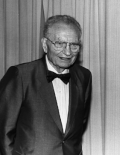
 United States of America
Explanation
Have you ever wondered how prices in a shop are set? Paul Samuelson used mathematics to describe how buyers and sellers behave, explaining why prices go up or down. He also studied how the whole economy changes over time, like when business conditions get better or worse. His ideas became textbook material used by teachers around the world. Thanks to him, it is easier for all of us to understand economic stories we hear in the news.
Related Keywords
static economic analysis
Static economic analysis studies market equilibrium by holding time constant and assuming variables do not change across periods. Samuelson rigorously formalized equilibrium conditions with demand-supply equations. This makes it easier to compare the immediate effects of policy interventions. The approach underlies modern supply-demand curve models and partial-equilibrium analysis. Introductory explanations of price formation are built on this framework.
dynamic economic analysis
Dynamic analysis tracks how economic variables change over time using mathematical equations. Samuelson employed difference-equation models like the multiplier-accelerator to reveal conditions for cyclical explosions or convergence. Dynamic models allow separate evaluation of short-run stimulus and long-run growth strategies. In modern macroeconomics they have evolved into DSGE models used for monetary-policy simulations. The work supplies foundational theory for analyzing paths of capital accumulation and technological progress.
comparative statics
Comparative statics is a method for mathematically comparing equilibrium points before and after a change in policy or an exogenous variable. Samuelson used envelope conditions to show how equilibrium prices and quantities move in response to parameter shifts. This allows signed predictions of the effects of taxes or import tariffs. Economists routinely use it as sensitivity analysis, and practitioners apply it to policy evaluation. It is an indispensable technique in both partial and general equilibrium studies.
general equilibrium theory
General equilibrium theory examines situations in which multiple markets reach equilibrium simultaneously. Samuelson formalized existence theorems and stability conditions, providing mathematical support for Walrasian adjustment processes. This made it possible to integrate results from individual market analyses into a whole-economy perspective. The framework is used to discuss optimality in international trade and resource allocation. It also serves as a theoretical premise for computable general-equilibrium (CGE) models.
welfare economics
Welfare economics evaluates how economic activity affects overall social wellbeing. Samuelson proposed the Bergson-Samuelson social-welfare function, showing how to aggregate individual utilities. This made it possible to quantify the effects of redistributive policies. He also contributed to the theoretical justification of optimal public-good provision and Pigouvian taxation. His work is a starting point for contemporary studies on the relation between social welfare and market mechanisms.
revealed preference theory
Revealed preference theory infers a consumer’s preference ordering from observed behavior. Samuelson introduced the Weak Axiom of Revealed Preference (WARP), enabling tests of whether choice data are consistent with utility maximization. Its hallmark is that demand functions can be estimated from actual purchase records without relying on questionnaires. The approach is widely used in empirical microeconomics and market-design studies. It is also employed in comparisons with behavioral-economics findings, bridging theory and experiment.