1920 Nobel Peace Prize
Reason for Award
for his longstanding contribution to the cause of peace and justice and his prominent role in the establishment of the League of Nations, including serving as President of its first Assembly
Laureates
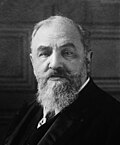
 France
Explanation
Léon Bourgeois devoted himself to creating a “League of Nations,” a club where countries could talk instead of fight. The League of Nations was a place where nations gathered to discuss problems and avoid wars. Bourgeois served as chairman of the League’s first big meeting and helped write rules so that everyone could get along. It is a bit like a class president who stops quarrels and gathers ideas during a class meeting at school. Thanks to his work, a system for countries to talk with each other was built for the first time in the world. His efforts were honored with the Nobel Peace Prize in 1920.
Related Keywords
League of Nations
Founded in 1919 after World War I, the League of Nations was the first universal inter-governmental organization devoted to world peace, headquartered in Geneva. Members were obliged to submit disputes to the Council or Assembly and to refrain from force until a decision was rendered. With a permanent Secretariat and numerous expert committees, the League promoted cooperation on minority protection, narcotics control, aviation, health, and more. Although hampered by U.S. absence, the unanimity rule, and great-power withdrawals, it pioneered institutions such as the Permanent Court of International Justice and the International Labour Organization. Dissolved in 1946, its assets and many functions were transferred to the United Nations.
Collective security
Collective security is the principle whereby a group of states treats an attack on any one member as an attack on all and responds jointly against the aggressor. Article 16 of the League Covenant codified this idea, providing for economic sanctions and, if necessary, military assistance to isolate a violator. Theoretically more deterrent than balance-of-power politics, the scheme struggled in practice because key powers abstained or disagreed on enforcement. The United Nations collective security system under Chapter VII of the Charter inherits the concept, with Security Council resolutions during the Korean and Gulf Wars serving as applications. Bourgeois played a pioneering role in early institutional debates, stressing the automatic character of sanctions.
International arbitration
International arbitration places legal or factual disputes between states before a neutral third party whose award the parties pledge to accept. The Permanent Court of Arbitration (PCA) was created at the Hague Peace Conferences, where Bourgeois promoted a treaty on compulsory arbitration. The League Covenant encouraged parties to submit cases to arbitral or judicial bodies, seeking to institutionalize war avoidance. Although arbitral awards are legally binding, they rely on voluntary compliance, making linkage with collective sanctions desirable. Arbitration remains central to international law today, from PCA interstate cases to investment disputes.
World War I
Fought from 1914 to 1918, World War I was the first total war, driven by rival alliances and imperial competition among great powers. It claimed more than ten million lives and caused unprecedented material devastation, forcing a reordering of international relations. The Treaty of Versailles signed at the 1919 Paris Peace Conference incorporated the Covenant of the League of Nations. The war’s horrors implanted a determination to prevent future conflicts and provided political momentum for creating a peace organization. Bourgeois’s ideas and Nobel recognition are inseparable from this historical context.
Solidarism
Solidarism emerged in late-19th-century France as a social philosophy positing reciprocal obligations among individuals and groups. Léon Bourgeois extended domestic solidarism to international relations, arguing that states share moral duties and common interests. He embedded this view in the League of Nations, seeking institutional designs that integrated dispute settlement, economic cooperation, and social justice. Solidarist thought influenced Keynesian adjustment schemes and the internationalization of social rights, foreshadowing the social policy dimensions of the UN and the EU. It offers a theoretical counterpoint to realist notions of absolute sovereignty and continues to inform debates on global public goods.