1933 Nobel Peace Prize
Reason for Award
for his authorship of “The Great Illusion,” his active support of the League of Nations, and his wide dissemination of anti-war arguments that fostered international peace
Laureates
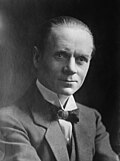
 United Kingdom of Great Britain and Northern Ireland
Explanation
Sir Norman Angell was a British writer who wanted very much to stop wars. He wrote a book called “The Great Illusion” that explained in simple words that countries do not really gain anything by fighting. Just as two shops that fight lose customers, countries that fight make life harder for everyone. Angell spread this idea in schools and newspapers and told people that talking together is better than fighting. He also supported the League of Nations, a meeting place where countries could solve problems by discussion. His work encouraged people around the world who were trying to make peace, and that is why he received the Nobel Peace Prize.
Related Keywords
The Great Illusion
Published in 1910, Angell’s flagship book argued that industrialization had tied national economies so closely together that war generated losses, not gains. Drawing on statistical tables and corporate balance sheets, it offered a data-driven case and was translated into many languages, selling over two million copies. On the eve of World War I it was widely read across Europe and cited in parliamentary debates and newspaper editorials. Today it is regarded as a seminal text for liberal peace theory and interdependence studies.
League of Nations
Founded in 1919 after World War I, the League of Nations was the first permanent international organization aimed at mediating disputes and encouraging cooperation in areas such as disarmament and public health. Angell collaborated with its Information Section, devising publicity strategies to convey the idea of peace to ordinary citizens. Posters, radio broadcasts and mobile cinemas were among the tools used to shape public opinion within member states, an effort often viewed as the prototype of today’s United Nations Department of Global Communications.
disarmament
The effort to reduce the quantity of weapons and armed forces held by states. Angell advocated disarmament from an economic perspective, arguing during the 1932-34 Geneva Disarmament Conference that public support was essential for success. He warned that arms races enlarge tax burdens and sovereign debt while stifling world trade. His analysis foreshadows modern debate on the opportunity cost of defence expenditure. Although only partial agreements—such as limits on chemical weapons—were achieved, the process set important precedents.
anti-war movement
A collective term for social movements opposing war and advocating peace. From the late 19th to early 20th century, trade unions, religious groups and women’s organizations joined forces to stage mass rallies and petitions. Angell lectured at these events, supplying an economic rationale that strengthened the movements’ theoretical foundation. His writings served as key texts, frequently cited in pamphlets and debate clubs. The movements exerted pressure on policy-makers and helped advance disarmament and international agreements.
international cooperation
The act of states or international bodies working together toward shared goals. Angell highlighted the mutual benefits of trade and information exchange, depicting cooperation as a ‘positive-sum game’. His view underpins modern multilateral mechanisms such as the UNFCCC or the WTO. The hypothesis that trust accumulated through cooperation decreases the likelihood of conflict has become a topic of empirical research in International Relations. The Nobel Committee esteemed Angell’s role in popularizing this cooperative ideal.
economic interdependence
The interconnectedness of national economies through cross-border trade, investment and finance. Angell argued that the deeper the interdependence, the higher the cost of war, making peace the rational option. This hypothesis evolved into ‘commercial peace theory’ and strongly influenced post-WWI international economics and IR scholarship. Today the concept remains central in analyses of supply-chain disruption and economic sanctions. Trade-to-GDP ratios and stocks of FDI are common indicators used to measure interdependence.
liberal peace theory
A theoretical framework positing that liberal factors—democracy, trade, and international organizations—help deter war. Angell’s writings provided an early formulation that later merged with Kant’s idea of perpetual peace and the modern democratic peace literature. The theory has been tested through statistical analyses and case studies and strongly influenced post-Cold-War order building. Critics argue that it underestimates power politics and overlooks colonial aspects, yet liberal peace theory remains a key reference in international policy debates.