1950 Nobel Peace Prize
Reason for Award
for his successful mediation in Palestine and his contribution to the armistice negotiations between the Arab states and Israel
Laureates
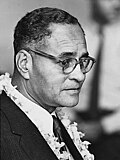
 United States of America
Explanation
Ralph Bunche worked to stop fights between countries through mediation, a way of helping people talk. In 1948–1949 Israel and several Arab countries were at war, and he invited them to meetings and asked them to stop shooting first. He listened carefully to what each side wanted and tried to find ideas both could accept. Thanks to his effort they signed an armistice, putting down their guns and saving many lives. By showing that talking can replace fighting, Bunche received the Nobel Peace Prize. When we make peace with our friends by listening to them, we are doing a small version of what Bunche did.
Related Keywords
United Nations
The United Nations was founded in 1945 after World War II with the primary purpose of maintaining international peace and security. Its Security Council issues resolutions on armed conflicts and may mandate cease-fires or peacekeeping operations. As a senior official in the Secretariat’s Department of Political Affairs, Ralph Bunche played a key role in the organization’s first major mediation effort. The success in Palestine demonstrated that the UN could act not merely as a forum for debate but as an operational actor. Today the UN remains central to conflict management through PKOs, sanctions regimes, and diplomatic initiatives worldwide. Nonetheless, structural challenges such as the veto power of permanent members and budgetary limitations persist.
Palestine conflict
The Palestine conflict originated from the clash between Zionist state-building aspirations and Arab nationalism. Since the 1947 partition plan, several Arab-Israeli wars and intifadas have erupted, and a final two-state settlement remains elusive. The first Arab-Israeli war of 1948–49 ended with armistice agreements mediated by Ralph Bunche, yet issues such as refugees persisted. The conflict combines territorial, religious, resource, and refugee-rights dimensions, making it a protracted, multi-layered problem. Current peace talks and UN resolutions operate against this historical and legal backdrop. Resolving the conflict is seen as pivotal for regional stability and remains a global diplomatic priority.
Armistice Agreement
An armistice agreement is a formal instrument by which belligerents suspend hostilities; unlike a peace treaty, it usually omits final settlement terms. In 1949 Israel signed four armistice agreements with Egypt, Jordan, Lebanon, and Syria under UN auspices. These accords established the so-called Green Line as a provisional boundary and created the UN Truce Supervision Organization to monitor compliance. They included practical provisions on refugee return, prisoner exchanges, and demilitarized zones. When armistices endure, they often function as de facto borders and starting points for subsequent political negotiations. However, if final peace is delayed, the legal ambiguity inherent in an interim accord can itself become a source of renewed conflict.
Mediation
Mediation is a method of international conflict resolution in which a neutral third party helps disputants settle their differences. The mediator structures talks, clarifies positions, and proposes compromises or mutually beneficial solutions. Ralph Bunche earned trust as an honest broker, using a multi-track strategy that blended confidential shuttle diplomacy with public sessions. The key to success lies in maintaining parties’ incentives to negotiate while applying calibrated external pressure. Today mediation is conducted by the UN, regional bodies, and NGOs, and its techniques continue to evolve, including the use of online platforms.
Middle East peace
Middle East peace refers to ongoing diplomatic efforts to establish a lasting settlement among Israel, its neighbors, and the Palestinian people. Milestones since the 1949 armistices include the Camp David Accords, the Oslo Accords, and the Madrid Peace Conference. Negotiations address complex issues such as borders, water resources, refugees, and the status of Jerusalem. The peace process is linked not only to regional stability but also to global concerns like energy security and counter-terrorism. Alternating successes and setbacks make Middle East peace a long-term project that tests the patience and creativity of the international community.
United Nations Truce Supervision Organization
Established in 1948, UNTSO was the UN’s first peacekeeping-type mission, tasked with supervising the Palestine cease-fire. Its military observers are officers from non-belligerent countries who report directly to the Security Council and the Secretary-General. UNTSO became the prototype for later PKOs, pioneering techniques such as patrols, aerial observation, and radar monitoring. Its area of operations has expanded to the Sinai Peninsula, the Golan Heights, and other parts of the Middle East, providing early warnings that helped prevent renewed wars. Although small in budget and size, its continuous presence underpins confidence in international monitoring mechanisms.
Multilateral diplomacy
Multilateral diplomacy involves negotiations or consultations among several states and international organizations to resolve issues jointly. UN conferences are classic examples, seeking to build order through common norms and rules rather than sheer power. In the Palestine mediation, multilateral diplomacy had to reconcile the interests of major powers such as the United States, the United Kingdom, France, and the Soviet Union. Ralph Bunche exchanged information bilaterally with delegations while forging consensus in plenary sessions, showcasing the craft of multilateralism. As global challenges grow more complex, multilateral diplomacy is indispensable for areas ranging from climate change and pandemics to arms control.