1951 Nobel Peace Prize
Reason for Award
for his contribution to the establishment of the International Labour Organization
Laureates
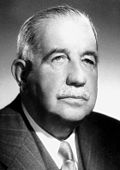
 France
Explanation
Léon Jouhaux was a man who helped factory workers stay safe and be treated fairly. Together with his friends, he worked hard to create the International Labour Organization (ILO), where countries meet to make rules for work. Thanks to the ILO, children cannot be forced to work long hours and workplaces must be safe. These rules lower the chances of fights between nations and help everyone live more peacefully. That is why Jouhaux was given the Nobel Peace Prize.
Related Keywords
International Labour Organization
Founded in 1919, the ILO is now a UN specialised agency with a tripartite structure of governments, employers and workers. It has adopted more than 190 conventions and over 200 recommendations on issues such as minimum wage and occupational safety, requiring member states to implement them. Committed to preventing conflict through social dialogue, the ILO itself won the Nobel Peace Prize in 1969. It delivers technical assistance to developing countries and maintains ILOSTAT, a comprehensive labour-market database, directly supporting the SDGs goal of “decent work.” By harmonising labour standards internationally, the ILO mitigates socially destabilising race-to-the-bottom competition and thus buttresses peace.
Trade union movement
The trade union movement is a social movement in which workers collectively bargain over wages, hours and conditions. Originating in 19th-century Europe during the Industrial Revolution, it expanded to international solidarity in the 20th century. Jouhaux led the French CGT and focused on embedding collective bargaining power into legal frameworks. Unions help equalise income distribution and stabilise industrial relations, thereby lessening social tensions and reducing the likelihood of violent conflict. The movement remains central to ILO core conventions such as No. 87 on freedom of association and No. 98 on the right to collective bargaining.
Social justice
Social justice is the equitable distribution of resources and opportunities among individuals and groups. Jouhaux believed that the absence of social justice was a root cause of wars and revolutions. The ILO Constitution explicitly states that ‘universal and lasting peace can be established only if it is based upon social justice,’ and sets international standards for wages, safety and working hours. Contemporary empirical studies likewise demonstrate that reducing economic inequality increases the durability of peace. SDG Goals 8 and 10 are predicated on achieving social justice.
Tripartism
Tripartism is a governance mechanism in which governments, employers and workers each hold equal voting power in policy decisions. The ILO is the world’s only permanent tripartite body, and each group holds one-third of the votes in adopting conventions or budgets. By institutionalising interest reconciliation, tripartism reduces the need for strikes and riots as extra-institutional tactics. Studies show that tripartite governance raises compliance rates and the durability of international agreements. Jouhaux referred to this model as a “social parliament for peace.”
Child labour prohibition
Child labour prohibition aims to protect children—generally under 15—from harmful or excessive work. ILO Conventions 138 and 182 set global standards that nearly all member states have ratified. Already in Jouhaux’s era, child labour was condemned for perpetuating social inequity and denying educational opportunity. Reducing child labour raises school attendance and, over time, improves the Human Development Index. Contemporary efforts emphasise international monitoring and corporate supply-chain due diligence.
Social dumping
Social dumping occurs when countries or firms exploit lower labour standards to cut production costs and gain a competitive edge. Competitive reductions in wages or safety standards erode living conditions and provoke social unrest, so Jouhaux argued for international minimums via the ILO. Modern trade agreements include ‘labour chapters’ with sanction mechanisms for violations. OECD and WTO discussions likewise treat social dumping as a threat to sustainable growth. Upholding standards is viewed as essential for long-term market integrity and peace.
Versailles Treaty Part XIII
Part XIII of the 1919 Versailles Treaty contained labour clauses that became the ILO Constitution. It codified principles such as the eight-hour day and the protection of women workers. Jouhaux, as a workers’ delegate, was heavily involved in drafting it and institutionalising tripartism and convention-adoption procedures. Because World War I was seen as a consequence of injustice, the treaty framed social justice as essential to peace. Part XIII also influenced later international human-rights instruments, notably the ICESCR.