1962 Nobel Peace Prize
Reason for Award
for his fight against the nuclear arms race between East and West and for leading an international movement demanding a halt to nuclear testing and the pursuit of disarmament
Laureates
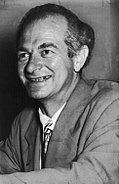
 United States of America
Explanation
Linus Pauling spoke out against many countries building very scary nuclear bombs. He said, “Let’s be friends instead of making bombs,” and wrote letters to people all over the world to gather signatures. Thanks to him, some of the nuclear tests were stopped, helping to protect Earth and people’s health. It is like a class leader who asks everyone to stop a dangerous game so the classroom stays safe. Because of this brave action, he received the Nobel Peace Prize.
Related Keywords
nuclear weapons
Weapons that exploit the enormous energy released by nuclear fission or fusion, producing heat, blast and radiation simultaneously. After the bombings of Hiroshima and Nagasaki, stockpiles grew rapidly during the Cold War. Yields range from tens of kilotons to several megatons, causing unparalleled humanitarian and environmental destruction. Deterrence theory and the concept of Mutual Assured Destruction embedded these arms in security doctrines, yet risks of accidents or mislaunch persist. Global campaigns and UN treaties continue to call for their complete abolition.
Partial Test Ban Treaty
Signed in 1963 by the USA, UK and USSR, the treaty prohibits nuclear tests in the atmosphere, outer space and underwater, making it one of the earliest arms-control accords. Underground tests were not covered, yet fallout levels dropped sharply after its entry into force. During the negotiations Pauling’s scientist petition and fallout data shaped public opinion and influenced policymakers. The treaty paved the way for later agreements such as the Comprehensive Test Ban Treaty (CTBT) and strategic arms limitation talks. Compared with the still-unratified CTBT, the PTBT is viewed as a pragmatic compromise between deterrence and environmental protection.
Cold War
The period roughly from 1947 to 1991 when the Western bloc led by the United States and the Eastern bloc led by the Soviet Union confronted each other in military, political, economic and ideological spheres. Although full-scale war was avoided, proxy wars, intelligence contests, the space race and nuclear arms buildup intensified. While nuclear parity deterred largescale conflict, citizens lived with constant fear of nuclear annihilation. Scientific and cultural arenas saw both competition and cooperation, and transnational movements such as the campaign to end nuclear tests emerged. Even after its end, Cold War legacies continue to shape international security and disarmament talks.
civil society movement
Voluntary collective action by citizens, independent of governments or firms, aimed at addressing social problems. Methods include petitions, demonstrations, workshops, and today extensive use of social media. In Pauling’s era paper petitions and open letters were typical, and the involvement of scientists with specialized knowledge was distinctive. Civil society movements exert pressure on policymakers while also shaping public agendas. In the modern world they organize transnational networks on issues such as climate change, gender equality and human rights.
social responsibility of scientists
The idea that scientists should recognize the societal impact of their research and act with awareness of risks and ethics. After the Manhattan Project, many researchers reflected on their role and advocated disarmament through arenas like the Pugwash Conferences, shaping the concept. Pauling pioneered translating technical knowledge into public language and policy advocacy. In contemporary contexts such as AI and gene editing, similar ethical debates are demanded. Codes of conduct and risk-assessment guidelines of scholarly societies have been developed under this principle.
petition campaign
A method of collecting supporters’ signatures on a specific policy or social issue and submitting them to governments or international bodies to spur change. Petitions not only visualize public opinion through numbers but also help build networks among participants. Pauling’s scientists’ petition leveraged the professional credibility of researchers and influenced the legitimacy of political negotiations. Today online platforms make cross-border mass petitions easy, greatly lowering the cost of expression. Maximizing impact now often requires integration with media strategies and complementary policy proposals.