1973 Nobel Peace Prize
Reason for Award
for having jointly negotiated a ceasefire in Vietnam in 1973
Laureates
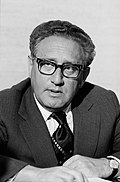
 United States of America
 North Vietnam
Explanation
In Vietnam a long war had been raging since the 1960s. Many nations, including the United States and North Vietnam, were involved and people suffered greatly. Henry Kissinger and Le Duc Tho began talks to stop the fighting. This action is called a “peace negotiation.” They met many times in Paris, deciding when to end shooting and how to return prisoners. Their work led to the 1973 “Paris Peace Accords,” a big step toward silencing the guns. For this effort they were awarded the Nobel Peace Prize.
Related Keywords
Vietnam War
The Vietnam War lasted from 1955 to 1975 and pitted the U.S.-backed South Vietnamese government against North Vietnam and the National Liberation Front. As a Cold War proxy conflict, it featured massive aerial bombardment, the use of defoliants, and extensive civilian casualties that shook world opinion. Although the 1973 Paris Peace Accords triggered U.S. withdrawal, hostilities continued until the 1975 fall of Saigon. Media coverage and anti-war activism profoundly influenced policy making, a major subject in political science. Post-war reconstruction and diplomatic realignments remain central to understanding contemporary Southeast Asian security.
Paris Peace Accords
Signed on 27 January 1973, the Accords bore the signatures of the U.S., South Vietnam, North Vietnam, and the National Liberation Front. They stipulated an immediate cease-fire, withdrawal of U.S. and allied forces within 60 days, and mutual POW exchanges. An International Commission of Control and Supervision was created to monitor compliance, though its enforcement powers were limited. The text envisaged nationwide elections for political settlement but lacked concrete procedures, which hindered implementation. Despite failing to secure lasting peace, the treaty had tangible effects in ending U.S. combat involvement and reducing hostilities.
ceasefire
A ceasefire is an agreement to halt hostilities temporarily or permanently and is often the first phase of a peace process. In Vietnam the ceasefire took effect at 08:00 local time on 28 January 1973. Because demarcation and monitoring mechanisms were weak, localized skirmishes persisted. Under international law, ceasefire violations entail serious responsibility, yet enforcement gaps can erode compliance. Durable cessation of violence requires strong political will and confidence-building measures by third parties.
Cold War
The Cold War was an era after World War II in which the U.S.-led capitalist bloc and the Soviet-led socialist bloc engaged in arms races and proxy wars while avoiding large-scale direct conflict. The Vietnam War became a prime battlefield in this ideological confrontation, prolonging violence. International relations scholars examine how the Cold War constrained and expanded the diplomatic options of smaller states. During the détente of the 1970s, U.S.–China rapprochement and U.S.–Soviet arms talks indirectly shaped the Vietnam peace negotiations. Even after the Cold War’s end, intervention models and alliance structures formulated then still influence contemporary security studies.
diplomatic negotiation
Diplomatic negotiation is the process by which states or conflict parties reconcile interests and build agreements, essential for preventing or ending wars. In the Vietnam peace process, secret bilateral talks ran parallel to formal multilateral conferences. To offset information asymmetry, meetings were held in a third country and unpublished memoranda were exchanged. Constructive ambiguity—leaving certain clauses vague—allowed parties to present divergent domestic interpretations. Negotiation theory highlights BATNA analysis as a decisive factor in such complex bargaining.
secret diplomacy
Secret diplomacy employs undisclosed channels to build trust and enable faster communication. The U.S.–North Vietnam back-channel allowed frank exchanges that the formal table could not, creating a breakthrough. While secrecy can avoid domestic backlash, lack of transparency may hinder later compliance. Historians rank it alongside pre-WWI secret treaties and the Oslo Accords as emblematic cases. In the digital age, leak risks have grown, making information security crucial.
peace process
A peace process is a comprehensive effort in which adversaries move step-by-step through ceasefire, political agreement, confidence building, and governance transition. In Vietnam the ceasefire and foreign troop withdrawal succeeded, but insufficient domestic political integration led to renewed war. Theoretically a peace process comprises multilayered mechanisms of implementation, economic aid, and societal reconciliation. United Nations or regional bodies often act as external guarantors, yet 1970s Vietnam lacked such an overarching framework. Comparative studies underscore the importance of shared legitimacy and renewed security guarantees for sustainable peace.