1975 Nobel Peace Prize
Reason for Award
for his struggle for human rights in the Soviet Union, for disarmament and cooperation between all nations
Laureates
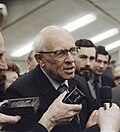
 Soviet Union
Explanation
Andrei Sakharov was a Russian scientist. He helped design very powerful bombs but became worried about people being hurt by war. So he spoke out, saying, “Let’s get rid of nuclear weapons and let people talk freely.” It took great courage to disagree with his government, yet he never gave up. Because of this brave work he received the Nobel Peace Prize.
Related Keywords
human rights
The inherent freedoms and dignities purportedly held by all people. Sakharov treated freedom of speech, assembly, equality before the law, and relief for political prisoners as priorities equal to nuclear disarmament. Openly advocating these rights in the USSR was perilous, yet he invoked international law—especially the Universal Declaration of Human Rights—to press the government. His stance strongly influenced Amnesty International and the Moscow Helsinki Group. By stressing the universality and indivisibility of rights he helped shape the post-Cold-War human-rights regime.
disarmament
The gradual reduction and elimination of military capabilities held by states. Sakharov focused on nuclear warheads, advocating quantitative and yield ceilings enforced by reciprocal verification. His concepts informed later treaties such as INF and START and established a precedent for scientists’ involvement in arms-control processes. By framing disarmament as both curbing hostility and reallocating resources to welfare, he contributed to the emergence of peace economics.
nuclear weapons
Weapons that exploit nuclear reactions to deliver immense destructive energy. Sakharov was instrumental in hydrogen-bomb development but later warned of the catastrophic effects of nuclear war. After the 1961 Tsar Bomba test he published calculations on fallout and climatic impacts, arguing for a comprehensive test ban. These estimates became technical inputs for PTBT negotiations and provided early hints of the ‘nuclear winter’ debate.
freedom of speech
The right of individuals and groups to express opinions without fear. In the USSR strict censorship made government criticism punishable. Sakharov used samizdat (underground publishing) and interviews with foreign media to bypass controls and broadcast information. His actions became a symbol of resistance and influenced the later relaxation of speech restrictions during perestroika.
Sakharov Memorandum
Refers to Sakharov’s 1968 essay “Reflections on Progress, Peaceful Coexistence, and Intellectual Freedom,” which explored links between runaway technology and human-rights repression. He urged scientists to abandon political indifference and embrace public ethics. The document was translated and widely circulated abroad, generating significant global attention.
Soviet dissident movement
A network of writers, scientists, clergy, and others who criticized the Soviet system from the 1960s onward. Through samizdat and petitions they exposed human-rights violations. Sakharov became a leading figure whose example encouraged fellow dissidents. Glasnost later brought their issues into the open and influenced democratization.
Cold War
The post-WWII geopolitical confrontation between the US and USSR involving arms races and ideological rivalry. Nuclear war remained a constant threat. Sakharov’s proposals supplied theoretical grounds for dialogue and contributed to the progress of détente.
civil society
The sphere of voluntary associations independent of state and market that pursue the common good. Sakharov viewed a robust civil society as the guarantor of peace and liberty, supporting NGOs and independent unions. The concept influenced democratization movements in Eastern Europe.
Nobel Peace Prize
An international award established in Alfred Nobel’s will, honoring outstanding contributions to peace. The 1975 award became a landmark demonstrating the importance of scientists speaking out ethically and has influenced subsequent prize criteria.
social responsibility of scientists
The idea that researchers should assume proactive responsibility for how science and technology affect society. Drawing on his experience with nuclear weapons, Sakharov became a pioneer practitioner of this responsibility. Modern ethics committees and guidelines (e.g., the Asilomar Declaration) inherit his principles.