1986 Nobel Peace Prize
Reason for Award
for serving as Chair of the Presidential Commission on the Holocaust
Laureates
 United States of America
Explanation
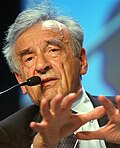
Elie Wiesel worked hard to tell the world about the “Holocaust,” the terrible events during World War II when many Jewish people were hurt and killed. The President of the United States asked him to lead a special group that would make sure people never forget the Holocaust. By writing books and giving talks, he shared his own painful experiences and taught everyone that such cruelty must never happen again. Because this helps people live together peacefully, he received the Nobel Peace Prize. He shows us how important it is to respect and care for one another.
Related Keywords
Holocaust
The Holocaust refers to the mass genocide perpetrated by Nazi Germany during World War II, resulting in the deaths of about six million Jews and other minorities. It is considered one of the largest atrocities in human history. Remembering and studying it is seen as vital for preventing discrimination and xenophobia today. Wiesel’s testimonial literature made its realities visible and cemented its lessons in global consciousness. Memory is now transmitted through education, museums, and commemorative events worldwide.
culture of memory
The culture of memory studies how societies remember, share, and assign meaning to past events. Monuments, museums, commemorative days, and school curricula are institutional elements. Wiesel’s commission built public infrastructure for Holocaust memory in the United States. Cultural memory shapes identity formation and influences policy decisions. It is also an interdisciplinary field exploring how historical lessons can aid peacebuilding.
human rights
Human rights are the inherent rights every person possesses. Legal frameworks such as the UN Universal Declaration of Human Rights and the Geneva Conventions were strengthened after the Holocaust. Wiesel labeled silence toward violations as “the sin of neutrality,” preaching an ethic of action. His work became a model for cross-border solidarity and assistance. The concept remains fundamental in confronting discrimination and violence today.
Presidential Commission
A Presidential Commission is a temporary or permanent advisory body convened by the U.S. President. The Commission on the Holocaust was established in 1978 with Elie Wiesel as chair. It gathered survivor testimonies, drafted plans for a museum, and recommended educational programs. Its report became the legislative foundation for federal action, helping institutionalize Holocaust remembrance. It serves as a model for governments addressing historical crimes.
reconciliation
Reconciliation is the process in which groups with histories of conflict rebuild trust through dialogue, rituals, and compensation. Wiesel stressed that perpetrators and victims must share the truth and offer apologies to build the future. It involves both judicial mechanisms (e.g., reparations laws) and non-judicial mechanisms (e.g., commemorations). Successful examples include South Africa’s Truth and Reconciliation Commission. The concept greatly contributes to the long-term sustainability of peacebuilding.
testimonial literature
Testimonial literature is a genre in which personal experiences narrate historical tragedies. Wiesel’s “Night” is a seminal work, portraying the psychological horrors of the Holocaust with concise, symbolic prose. Readers learn history and emotion simultaneously through the narrative. Such literature is valued both as historical source material and as ethical education. It is a key object of analysis in trauma studies and memory studies.
peace education
Peace education is a field that teaches history, ethics, and dialogue skills to prevent violence and promote coexistence. Using the Holocaust as teaching material is considered effective for fostering empathy and preventing discrimination. Wiesel lectured at universities worldwide, encouraging youth to act courageously. Peace education aligns with UNESCO’s Education for Sustainable Development (ESD). Curricula that balance critical thinking with emotional empathy are emphasized.
United States Holocaust Memorial Museum
Opened in 1993 in Washington, D.C., the U.S. Holocaust Memorial Museum was created based on the commission’s recommendations, with Wiesel serving as honorary chairman. Its permanent exhibition centers on survivor testimonies and personal artifacts, giving visitors a visceral sense of history. An attached research center promotes archival work and scholarly exchange. The museum functions as a public hub that provides both historical education and a warning against future atrocities.