1992 Nobel Peace Prize
Reason for Award
for her struggle for social justice and ethno-cultural reconciliation based on respect for the rights of indigenous peoples
Laureates
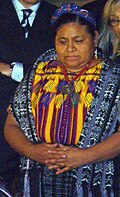
 Guatemala
Explanation
Rigoberta Menchú is a Maya woman born in the mountains of Guatemala. Her family and neighbors were often treated unfairly and could not easily use schools or hospitals. From a young age she wanted to end this unfairness, so she collected people’s stories and spoke to the government. The work was dangerous, and she sadly lost members of her family, but she did not give up. Thanks to her efforts, more indigenous children could go to school and new laws began to protect their land. The world honored her courage and hard work by giving her the Nobel Peace Prize in 1992.
Related Keywords
Indigenous rights
Indigenous rights refer to the legal and political entitlements that allow native peoples to maintain their culture, land, and language with dignity. They are codified in instruments such as the UN Declaration on the Rights of Indigenous Peoples and ILO Convention 169, emphasizing self-determination and protection of traditional knowledge. Menchú’s activism had a tangible impact on drafting and disseminating these instruments. In Guatemala it translated into land-restitution lawsuits and improved language policies. Solidarity among indigenous movements worldwide continues to strengthen the global human-rights architecture.
Testimonio literature
Testimonio is a Latin American narrative genre in which oppressed people recount collective experiences in their own voice. “I, Rigoberta Menchú” is a seminal example, bringing the perspective of Maya peoples to Western audiences. Academia debated its accuracy and editorial process, but it highlighted the politics of marginalized narratives. The genre has expanded methodologies in oral history within media studies and anthropology. It is now widely used in post-conflict memory building.
Guatemalan Civil War
The Guatemalan Civil War lasted from 1960 to 1996, pitting government forces against leftist guerrillas. Over 200,000 people died, the majority of them indigenous civilians. U.S. anti-communist policy and Cold War dynamics deepened external involvement, leading to state-sponsored massacres. Although the 1996 Peace Accords ended open conflict, transitional justice and land disputes persist. Menchú’s testimony was pivotal in bringing global attention to the war’s realities.
Truth Commission
A truth commission is a temporary body that investigates human-rights violations during conflict or dictatorship and creates an official record. Guatemala’s Historical Clarification Commission, established in 1997, documented more than 60,000 cases and assigned primary responsibility to state forces. Its report informed reparations policies and memorial projects, advancing reconciliation. Menchú advised the commission and facilitated the gathering of indigenous testimonies. The model has influenced similar bodies in South Africa, Peru, and elsewhere.
ILO Convention No. 169
Adopted in 1989, ILO Convention 169 is the key international treaty protecting the rights of indigenous and tribal peoples, mandating the safeguarding of lands, resources, and cultural autonomy. Ratifying states must follow the principle of FPIC and include indigenous peoples in development planning. Menchú actively supported ratification campaigns, spurring policy shifts across Latin America. The convention also influences corporate supply-chain audits and ESG investment metrics. Strengthening compliance monitoring remains a major challenge.
Social justice
Social justice refers to the fair distribution of resources and opportunities without discrimination or oppression. Menchú highlighted intersecting inequalities of class, ethnicity, and gender, advocating for better access to education and healthcare. The concept is embedded in the Sustainable Development Goals and guides international policy. Academic work has refined metrics of inequality and theories of distributive justice, enabling multifaceted evaluations. It is regarded as indispensable in peace-building and transitional-justice frameworks.
Ethno-cultural reconciliation
Ethno-cultural reconciliation is the process of overcoming hostility and mistrust between different ethnic or cultural groups by fostering mutual respect and cooperation. In Guatemala a deep historical divide exists between indigenous and non-indigenous populations, making recognition of cultural rights central to peace. Menchú advanced reconciliation through education reforms and multilingual media that promoted mutual understanding. True reconciliation must link symbolic gestures to substantive rights such as land and political participation. Globally it is viewed as a key indicator of durable peace in post-conflict societies.
FPIC (Free, Prior and Informed Consent)
FPIC is an international standard requiring that indigenous peoples give free, prior, and informed consent before projects affecting their lands or resources proceed. It is embedded in ILO 169 and the UN Declaration on the Rights of Indigenous Peoples and is adopted in corporate environmental-social policies. Menchú led campaigns to apply FPIC to mining and dam projects. Practically, challenges include ensuring transparent consent processes and equitable benefit-sharing mechanisms. FPIC is considered a key governance tool for balancing climate-mitigation initiatives with resource development.