2001 Nobel Peace Prize
Reason for Award
for their work for a better organized and more peaceful world
Laureates

 World
World
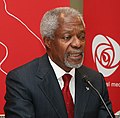
 Ghana
Ghana
Explanation
The United Nations is a big team that helps countries avoid fighting and sends food and water to people in trouble. Kofi Annan was like the captain of that team, encouraging everyone to get along. That’s why both the UN and Annan were honored together. Their prize reminds the world that peace is most important. We can learn that helping our friends is a small step toward world peace.
Related Keywords
peacekeeping operations
Peacekeeping operations (PKOs) involve troops and police from UN member states wearing blue helmets to monitor ceasefires and protect civilians. While the use of force is limited to self-defense and mandate provisions, recent missions permit calibrated coercion to safeguard non-combatants. Secretary-General Annan strengthened field-headquarters coordination and promoted integrated missions combining political, humanitarian, and security components. Standard Operating Procedures inspired by the Brahimi Report improved rapid deployment and mission quality. PKOs exemplify the award’s goal of a “better organized world.”
United Nations Charter
Signed in 1945, the UN Charter is the organization’s foundational treaty, committing states to maintain international peace and security, develop friendly relations, and promote cooperation. Chapter VII empowers the Security Council to take enforcement action, whereas Chapter VI stresses peaceful settlement. Annan highlighted the preamble’s phrase “We the Peoples,” proposing interpretations that elevate individual dignity and human rights. Flexible Charter application enabled post-Cold-War peacekeeping expansion, and the 2001 prize reaffirmed the centrality of a rules-based order. Contemporary SDGs and environmental agendas likewise rest on the Charter’s cooperative ethos.
disarmament
Disarmament seeks to reduce nuclear and conventional arms to lower conflict risks. The UN General Assembly First Committee and the Conference on Disarmament are principal negotiating fora. Under Annan, progress on small-arms control and the entry into force of the Mine Ban Treaty advanced frameworks that lessen civilian casualties. Disarmament aligns with the Nobel Peace Prize’s original focus on abolishing armaments. It also creates synergies with sustainable development, influencing today’s SDG approach that integrates peace and development.
humanitarian assistance
Humanitarian assistance provides food, medicine, and shelter to people affected by conflicts or disasters, safeguarding life and dignity. Within the UN, OCHA coordinates efforts executed by agencies such as UNHCR and WFP. Annan advocated the “continuum” between relief and development, aiming for seamless support from emergency response to long-term recovery. Cooperation with PKOs secures humanitarian corridors and strengthens civilian-protection norms. This comprehensive aid model underpins the vision of a more peaceful world.
Sustainable Development Goals
Adopted in 2015, the 17 Sustainable Development Goals (SDGs) cover poverty reduction, education, climate action, and more. Their predecessor, the Millennium Development Goals (MDGs), was championed by Annan in 2000, institutionalizing global indicators and progress reviews. The SDGs feature Peace, Justice, and Strong Institutions (Goal 16), highlighting the interdependence of security and development. The organizational capacity praised by the Nobel Committee lives on in the SDG implementation mechanism that unites multiple stakeholders. The tripartite partnership model of business, civil society, and government is now standard in international cooperation.
multilateralism
Multilateralism is an approach in which multiple states cooperate to solve international problems rather than acting bilaterally. The UN is the principal arena, providing shared rules through resolutions and treaties. Annan’s report “We the Peoples: The Role of the UN in the 21st Century” cast multilateralism as a public good in the age of globalization. Awarding the 2001 prize signaled renewed legitimacy for multilateral cooperation amid rising unilateralism. Current climate negotiations and pandemic responses follow this ethos.