2004 Nobel Peace Prize
Reason for Award
for her contribution to sustainable development, democracy and peace
Laureates
 Kenya
Kenya
Explanation
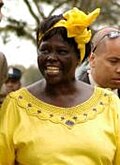
Wangari Maathai was a Kenyan woman who planted many trees to protect forests. She realized that when forests disappear, water and air become dirty and both animals and people suffer. So she started growing tree seedlings with local mothers and planting them in villages. This activity is called the Green Belt Movement and it spread around the world. She showed us that protecting forests is important for everyone’s healthy life.
Related Keywords
sustainable development
Sustainable development is the idea of meeting the needs of the present without compromising the ability of future generations to meet theirs, balancing environmental, social, and economic factors. Maathai operationalized this in rural Kenya by integrating tree planting with community incomes. Forest conservation restored watersheds, stabilizing agricultural productivity and generating long-term earnings. Institutionalizing women’s participation achieved social inclusion and anticipated many Sustainable Development Goals. Her work has influenced international development policy and is frequently cited as a practical sustainability model in low-income settings.
Green Belt Movement
Founded by Maathai in 1977, the Green Belt Movement is a grassroots NGO that links environmental protection with community development through tree planting. Its name reflects the vision of creating a "green belt" across Kenya. Women’s groups grow seedlings and receive small payments after successful planting, providing household income. The network evolved into a platform for policy advocacy and protest, contributing to Kenya’s democratization. Today it has chapters across Africa and beyond, serving as a model for transnational environmental movements.
reforestation
Reforestation is the intentional planting of trees to restore lost forests. It mitigates soil erosion, improves hydrological cycles, and sequesters carbon, offering multiple benefits. Maathai’s strategy prioritized indigenous species to maintain biodiversity and protect local ecosystems. Involving residents in the planting process created opportunities for environmental education and fostered stewardship. Reforestation is increasingly valued in climate policy and is incorporated into mechanisms like the Clean Development Mechanism and REDD+.
civil society
Civil society refers to the sphere of voluntary organizations that exist independently of the state and the market. Maathai believed that civil society could challenge environmental destruction and political corruption, and she linked NGOs and citizen groups together. The Green Belt Movement fostered community self-organization, enabling collective action for policy change. This grassroots power helped propel Kenya toward multiparty democracy and anti-corruption reforms. Civil society is now a key analytical concept in political science and sociology for assessing democratic health.
women's empowerment
Women’s empowerment denotes the process by which women gain agency in social, economic, and political decision-making. Through tree-planting activities, Maathai provided women with income and leadership opportunities. This not only stabilized household finances but also brought women’s voices into community decisions. Training programs further reduced gender-based discrimination. Maathai’s example demonstrates how environmental work can serve as a vehicle for gender equality.
environmental conservation
Environmental conservation encompasses efforts to protect natural ecosystems from degradation and pollution. Maathai argued that safeguarding forests is essential for water resources and climate stability. Her work emphasized preserving ecosystem services that underpin human livelihoods. She also spurred legal and policy changes, such as designating protected areas. Environmental conservation is now central to global strategies combating climate change and biodiversity loss.
democracy
Democracy is a political system in which citizens participate and choose representatives through elections. Kenya was under one-party rule for years, but Maathai used non-violent methods such as marches and park occupations to demand multiparty governance. She linked environmental rights with political participation rights, emphasizing the importance of citizens speaking out. Kenya began moving toward democratization in the late 1990s as a result. Her activism is often cited in democracy studies as evidence of the effectiveness of civic movements.
climate change
Climate change refers to long-term alterations in temperature and weather patterns driven mainly by increased greenhouse gases. Forests absorb and store CO₂, so their loss accelerates warming. Maathai’s reforestation increased carbon sinks, contributing to climate mitigation. She was an early voice highlighting Africa’s vulnerability to droughts and floods at international forums. Her advocacy helped link forest conservation to climate policy.
biodiversity
Biodiversity describes the variety of life on Earth and the richness of the ecosystems they form. Forests provide critical habitats for many species, and deforestation threatens this diversity. Maathai emphasized using native species in reforestation to restore and safeguard ecosystems. Forests with diverse species are more resilient to pests and climate stress. Her work demonstrated that development and conservation can coexist.
Kenya
Kenya is an East African country with diverse climates and ecosystems. After colonial rule and Cold War-era political influences, democratization movements gained momentum in the 1990s. Severe deforestation and land degradation have been persistent challenges, and Maathai’s initiatives addressed these national issues directly. Kenya remains the hub of the Green Belt Movement and is viewed as a pilot case for environmental policymaking. Maathai also became Kenya’s first female cabinet minister, symbolizing the link between politics and environmental stewardship.