2006 Nobel Peace Prize
Reason for Award
for their contribution to building the economic and social foundations of the poor through bottom-up development initiatives
Laureates
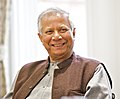
 Bangladesh
Bangladesh
Explanation
In many parts of the world, people who are poor cannot get regular bank loans. Muhammad Yunus from Bangladesh created a system called “microcredit” to lend these people small amounts of money. For example, someone can borrow money to buy chickens and then sell eggs to earn an income. The borrower pays the loan back in tiny portions with low interest, so it is not too hard. Helping poor people improve their lives in this way was recognized with the Nobel Peace Prize for Yunus and the Grameen Bank. The prize honors efforts that let people cooperate and build a peaceful society.
Related Keywords
microcredit
Microcredit is a financial service that lends amounts ranging from a few tens to a few hundreds of dollars to borrowers without collateral. Repayments are made in small weekly or monthly installments, offering an alternative to high-interest moneylenders or family borrowing. By using group lending and social collateral, default risk is contained and repayment rates stay high. The World Bank and the UN promote microcredit as a poverty-reduction instrument, and it is now merging with digital wallets and P2P platforms. Nonetheless, over-indebtedness and interest-rate caps remain contentious, requiring balanced regulation and self-discipline.
microfinance
Microfinance encompasses a full suite of financial services—loans, savings, insurance, remittances, and financial literacy—targeted at low-income populations. As client bases expand, a dichotomy has emerged between for-profit and NGO-type MFIs, posing challenges to balancing profitability with social impact. Fintech entry has popularized mobile money and AI-driven credit scoring, slashing transaction costs. Multilateral development banks supply capacity-building and guarantee facilities, making hybrid financing models mainstream. Advanced impact-evaluation methods now quantify spill-over effects on gender, health, and education.
group lending
Group lending requires several borrowers to form a small group that jointly guarantees each member’s repayment. Both theory and evidence indicate that information sharing and peer monitoring mitigate adverse selection and moral hazard. While operational costs are higher, the absence of collateral makes it accessible to the poor. When a member defaults, the entire group incurs a credit penalty, creating peer support and pressure simultaneously. In areas of rapid urbanization where social ties weaken, digital IDs and social-media data are being tested as substitutes for traditional group mechanisms.
financial inclusion
Financial inclusion means that everyone can access quality financial services at affordable cost and is deemed essential for meeting SDGs Goals 8 and 10. According to the World Bank’s Global Findex, the share of adults with an account rose from 51 % in 2011 to 76 % in 2021, yet gender and rural-urban gaps persist. Mobile money has spread rapidly in the poorest countries, complementing traditional branch networks. Policies such as e-KYC, agent banking, and regulatory sandboxes foster a conducive environment for private capital. Greater inclusion enhances household shock-resilience and firms’ access to capital, contributing to macroeconomic stability.
social business
Social business, a concept advanced by Dr. Yunus, is an enterprise that prioritizes solving social problems while sustaining itself through revenue. Investors seek social rather than dividend returns, and profits are reinvested. The model lies between traditional non-profits and purely for-profit firms, often evaluated using SROI metrics. It has been applied in renewable energy, healthcare, and education, supported by international impact-investment funds. Regulatory challenges include corporate forms and tax incentives, prompting multilateral agencies to draft supportive guidelines.
Grameen model
Originating in Bangladesh, the Grameen model of microfinance is built on solidarity groups, a focus on women, locality-based operations, and small, high-frequency repayments. Field officers conduct intensive pre- and post-loan monitoring, facilitating borrower education and community building. The model suits rural self-employment but requires design adjustments for urban or conflict settings. Numerous international NGOs have deployed localized versions in over 100 countries. Evaluation studies show that cultural and institutional variations affect outcomes, highlighting the need for social-structure adaptation when transferring the model.