1987 Nobel Memorial Prize in Economic Sciences
Reason for Award
for his contributions to the theory of economic growth
Laureates
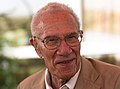
 United States of America
Explanation
When a country grows richer, we see new schools, roads, and shops. Mr. Solow studied "why countries become wealthier" using numbers. He showed that spending money on machines and buildings (capital), having more workers, and creating new ideas are all important. When these three work together, everyone’s life can slowly improve. His formula is in textbooks all over the world and offers hints on how to strengthen a nation’s economy. Even the smartphones we use every day are a good example of how new ideas drive economic growth.
Related Keywords
economic growth theory
A field of study that explains how a nation’s income and output expand over time, forming a core branch of macroeconomics. It models capital accumulation, labor force growth, and technological progress to analyze long-run prosperity and poverty. Policymakers use it to quantify the effects of tax cuts, education spending, and innovation support. Solow’s work established the standard framework and paved the way for later endogenous growth theories. It remains a touchstone in long-term projections by bodies such as the OECD and IMF.
Solow–Swan model
A neoclassical growth model introduced in separate 1956 papers by Solow and Swan. Assuming diminishing returns and exogenous technological progress, it shows how the saving rate, population growth, and depreciation determine the steady-state capital stock. By describing the speed of convergence to equilibrium, it underpins empirical tests of the convergence hypothesis. The framework separates level effects from growth-rate effects of policy, a useful feature for evaluation. It is a staple of graduate-level macroeconomic textbooks.
technological progress
The introduction of new inventions or more efficient production methods that allow more output from the same resources. In the Solow model it is taken as exogenous and is the key determinant of the long-run growth rate. Large-scale innovations such as the ICT revolution are shown to raise total factor productivity substantially. Endogenous growth theory explains technological progress internally through R&D investment and knowledge spillovers. Empirically, the Solow residual and patent statistics serve as proxies.
capital deepening
An increase in capital (machines, equipment) per worker. It boosts output and income in the short run, but diminishing returns mean its effect weakens over time. In the Solow model, a high saving rate or foreign investment drives capital deepening, yet without technological progress, the growth rate eventually approaches zero. Developing countries that rapidly expand infrastructure or factories without technology transfer risk falling into a middle-income trap. International agencies now recommend combining capital deepening with education and technology programs.
steady state
In growth models, a long-run equilibrium where per-capita variables like capital and output settle at constant levels. At the steady state, investment from saving exactly offsets depreciation and capital dilution from population growth. With exogenous technological progress, output still grows at the same rate, forming a “balanced growth path.” The theory predicts that after policy shocks or population changes, the economy converges back to this equilibrium over time. Empirical studies estimate the speed of convergence (β-convergence) using cross-country data to test the model’s validity.