1991 Nobel Memorial Prize in Economic Sciences
Reason for Award
for his discovery and clarification of the significance of transaction costs and property rights for the institutional structure and functioning of the economy
Laureates
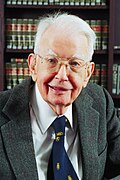
 United States of America
Explanation
When you buy something at a shop, you not only pay money but also wait in line and receive change—that extra effort is a kind of cost. Mr. Coase called such effort a “transaction cost.” He also showed that it is important to know exactly who owns what; that clear rule is called a “property right.” If transaction costs are low and property rights are clear, people and companies can trade smoothly and society works better.
Related Keywords
transaction costs
The costs of negotiating, gathering information, writing contracts, monitoring, and enforcing agreements in market exchange. Coase challenged the traditional assumption that these costs are zero and placed them at the heart of explanations for firm formation and institutional choice. The idea that minimizing transaction costs shapes economic organization now informs analyses ranging from vertical integration to digital platform design.
property rights
A bundle of rights to use, earn income from, and transfer an asset or resource. When these rights are clearly defined and inexpensive to enforce, parties can negotiate more easily, leading to efficient allocation. Coase showed that clear rights are a precondition for bargaining to internalize externalities, profoundly influencing law-and-economics and environmental policy research.
Coase theorem
The proposition that, with zero transaction costs and fully specified property rights, parties can negotiate to achieve an efficient allocation regardless of the initial distribution of rights. Because real-world transaction costs are positive, the theorem highlights the need for appropriate institutional design or policy intervention. It serves as a foundational reference when economists and policymakers address externalities.
externality
A situation in which the actions of one economic agent affect the welfare of others without those effects being reflected in market prices. Externalities can be negative, such as pollution, or positive, such as knowledge spillovers. Coase showed that negotiation backed by well-defined property rights can resolve externality problems, offering alternatives to tax-and-regulate solutions.
institutional economics
A field that studies how laws, customs, and contractual forms—the institutions surrounding economic activity—influence outcomes. Coase’s work laid the foundation for “New Institutional Economics,” fostering both theoretical models and empirical studies that treat institutions as endogenous. Active applications include property-rights systems, corporate governance, and political economy.
boundaries of the firm
The decision regarding which transactions to outsource to the market and which to perform internally. According to transaction-cost theory, when market coordination is costly, firms opt for vertical integration or diversification. The framework is now central to studies of platform companies and global value chains.