1999 Nobel Memorial Prize in Economic Sciences
Reason for Award
for his analysis of monetary and fiscal policy under different exchange rate regimes and his analysis of optimum currency areas
Laureates
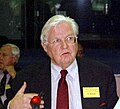
 Canada
Explanation
Around the world there are many kinds of money, and the value of each changes a little every day. Robert Mundell asked, “How should a country set the rules for its money so that people can have jobs and stable prices?” He put together an easy-to-read chart that combines a central bank’s interest-rate decisions (monetary policy) with a government’s taxes and spending (fiscal policy). For countries that trade a lot with others, he showed interest rates become especially important. He also explained what countries need if they want to share one currency, like the euro. Thanks to his work, people can better understand how the money system around them works.
Related Keywords
Mundell–Fleming model
An open-economy macro model that adds a balance-of-payments curve to the IS–LM framework, allowing visualization of how monetary and fiscal policies work under different exchange-rate regimes and degrees of capital mobility.
Optimum currency area
A concept identifying the conditions under which several countries benefit from sharing a single currency; if adjustment mechanisms such as labor mobility and fiscal transfers are strong, the gains from eliminating exchange-rate volatility exceed the costs of losing monetary autonomy.
Exchange rate regime
The set of rules governing how a currency’s external value is determined and maintained—ranging from fixed pegs to free floats or managed arrangements—each affecting policy autonomy.
Capital mobility
The degree to which financial assets can be traded across borders without restrictions; when high, funds flow quickly to arbitrage interest differentials, altering the transmission of monetary policy.
Monetary policy
Actions by a central bank to influence interest rates and the money supply in order to stabilize output and prices; in an open economy its effectiveness depends critically on exchange-rate interactions.
Fiscal policy
Government adjustments of spending and taxation to affect economic activity; Mundell showed its multiplier varies sharply with the exchange-rate regime.
Mundellian trilemma
The proposition that a country cannot simultaneously maintain a fixed exchange rate, free capital movement, and an independent monetary policy; only two of the three objectives can be achieved at once.
Euro introduction
The single European currency launched in 1999; widely cited as a practical application of Mundell’s theories in its design and convergence criteria.