1907 Nobel Peace Prize(2)
Reason for Award
for his role as a leading French international jurist and as a judge at the Permanent Court of Arbitration during the Hague Peace Conferences
Laureates
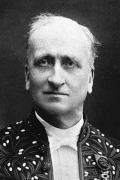
 France
Explanation
Mr. Renault helped countries solve their disagreements with laws instead of fighting. He took part in a big meeting of world representatives in The Hague, Netherlands, and served as a judge who listened to both sides fairly. Because of his efforts many nations could settle problems peacefully, so he received the Nobel Peace Prize.
Related Keywords
international law
International law is the legal system governing relations among states, composed of treaties, customary rules, and case law. In the late 19th century the creation of bodies like the Permanent Court of Arbitration and universal conferences gave it stronger positive-law characteristics. Renault strengthened its binding force by clarifying treaty interpretation academically and applying it in practice as an arbitrator. His writings were later cited during codification efforts by the International Law Commission. Today the field extends to new areas such as human rights and the environment.
Hague Peace Conferences
Held in 1899 and 1907 in The Hague, Netherlands, the Hague Peace Conferences were intergovernmental meetings that negotiated rules for disarmament and dispute settlement. The first conference created the Permanent Court of Arbitration; the second adopted detailed regulations on naval warfare and the Annex to the Laws and Customs of War on Land. Renault served as legal adviser to the French delegation at both sessions and worked closely with the presidium. The conferences became foundational stones for later institutions such as the League of Nations and the United Nations.
Permanent Court of Arbitration
Established at the 1899 Hague Conference, the Permanent Court of Arbitration (PCA) is the world’s oldest international dispute-resolution body. It can hear cases not only between states but also involving international organizations and private parties. Supported by an International Bureau and a roster of arbitrators, it offers flexible procedures. Renault was appointed a judge soon after its creation and rendered decisions in several cases. The PCA still handles major issues, such as the South China Sea arbitration, maintaining its authority in international arbitration.
Geneva Conventions
The Geneva Conventions are multilateral treaties aimed at protecting war victims, beginning with the 1864 treaty on wounded soldiers and revised several times in the 20th century. Renault provided advice during the 1906 revision, strengthening rules for aiding the wounded at sea. The conventions are the core of international humanitarian law and now comprise four main treaties with additional protocols. Serious violations can fall under the jurisdiction of the International Criminal Court.
laws of war
The laws of war are the body of international rules applicable during armed conflict, defining the rights and duties of belligerents and protecting civilians. The Hague and Geneva Conventions form its backbone, supplemented by custom and case law. Renault’s scholarship and practice clarified legal treatment of gray areas such as prize adjudication and surrender negotiations. Today the principles continue to guide norm-setting for cyber warfare and drone strikes.
rule of law
The rule of law is the principle that governments and individuals are bound by law, preventing arbitrary exercise of power. Internationally, it evolved into the idea that relations among states should likewise follow legal norms. Through the enforcement of arbitral awards, Renault demonstrated the rule of law at the global level. The concept is now embedded in the UN Charter and EU law, linking domestic and international legal orders.