1909 Nobel Peace Prize(2)
Reason for Award
for his distinguished diplomatic achievements in international arbitration to foster Anglo-French and Franco-German understanding
Laureates
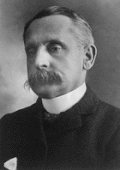
 France
Explanation
Paul-Henri d’Estournelles de Constant was a French diplomat who worked hard so countries could settle quarrels by talking. He suggested using court-like arbitration to help Britain and France—and France and Germany—understand each other better. He attended many meetings and helped people learn more about their neighbours. Thanks to his efforts, nations had more chances to avoid war. For this he received the Nobel Peace Prize in 1909. He teaches us that understanding others is the quickest path to peace.
Related Keywords
International arbitration
Arbitration lets an independent tribunal decide disputes so that war can be avoided. D’Estournelles championed arbitration treaties and succeeded in referring several Anglo-French and Franco-German cases. This proved arbitration’s practicality, not mere theory. He explained awards in newspapers, winning public support. The spread of arbitration paved the way for the inter-war Kellogg–Briand Pact.
Entente Cordiale
The Entente Cordiale is the 1904 friendship pact between Britain and France. It settled colonial boundaries and trade routes, ending decades of rivalry. D’Estournelles’ Senate speech called the pact ‘the cornerstone of peace,’ securing parliamentary approval. The Entente became the basis of wartime cooperation in WWI. Securing legislative backing showed how domestic support stabilises diplomacy.
Franco-German reconciliation
Franco-German reconciliation refers to overcoming hostility after the Franco-Prussian War. D’Estournelles exchanged visits with German deputies and organised joint cultural and educational events. The Baden Arbitration symbolised peaceful settlement of border issues. His work influenced later talks on the Rhineland problem after 1919. Such reconciliation is viewed as a prerequisite for European integration.
Inter-Parliamentary Union
The IPU is a forum of legislators worldwide; d’Estournelles was a co-founder. Through it he promoted arbitration treaties and human-rights agendas. In meetings he insisted that ‘parliaments are the last breakwater against war.’ The IPU inspired later bodies such as the League of Nations Parliamentary Conference and the European Parliament. It still lets MPs discuss global issues today.
Pacifist diplomacy
Pacifist diplomacy is negotiation without relying on military force, emphasising persuasion, arbitration and cultural exchange. D’Estournelles used speeches and publications to mobilise public opinion and support his diplomatic goals. His work is considered a classic example of soft power. Cultural exchange and public diplomacy remain vital tools for peacebuilding today.
Arms race
An arms race is the vicious cycle of states expanding their arsenals in response to each other. Early 20th-century Europe’s naval buildup is a textbook case. D’Estournelles argued that armament spending strained budgets and delayed social reforms. His speeches stressed that peace and economic progress go hand in hand and resonated with audiences. The dangers of arms races remain a central issue in security studies today.
Arbitration treaty
An arbitration treaty obliges or recommends parties to submit disputes to arbitration. The level of commitment depends on whether referral is automatic. D’Estournelles built ‘a chain of small successes’ by securing even limited-scope clauses, gradually increasing acceptance. This accumulation of practice improved the procedure’s credibility. Modern investment treaties now routinely include arbitration clauses.
Public diplomacy
Public diplomacy is outreach aimed directly at foreign publics to build understanding and support. D’Estournelles used newspaper columns and lecture tours to publicise arbitration cases and win popular backing. Such diplomacy is vital for legitimising policies at home and abroad. In today’s social-media era, its importance is even greater.
European international politics
Europe before WWI was a multipolar landscape of shifting alliances and rivalries. Pacts like the Entente Cordiale or the Dual Alliance shaped the balance of power. D’Estournelles’ work showed that dialogue and law could soften raw power politics in such a system. His efforts are often seen as a pre-history of European integration. Understanding this context gives his achievements greater depth.