1909 Nobel Peace Prize(1)
Reason for Award
for serving as a delegate to two Hague Peace Conferences and for leading the Inter-Parliamentary Union
Laureates
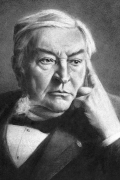
 Belgium
Explanation
Auguste Beernaert showed the world how important it is for countries to talk instead of fight. He took part twice in the big Hague Peace Conference where leaders tried to make rules to stop wars. He also headed a club of lawmakers called the Inter-Parliamentary Union so they could share ideas. Because of these meetings, nations could solve problems with words, not weapons. His efforts earned him the 1909 Nobel Peace Prize. He reminds us that friendly talks are the first step toward peace.
Related Keywords
Hague Peace Conferences
The Hague Peace Conferences were the first multilateral disarmament meetings. Delegates debated arms limitation, the laws of war and peaceful settlement of disputes. Topics ranged from banning poison gas shells to drafting rules of engagement, laying the groundwork for modern international humanitarian law. Beernaert, as a Belgian delegate, helped steer the talks and secure adoption of the Arbitration Convention. The conferences’ legacy influenced the League of Nations and even the UN Charter.
Permanent Court of Arbitration
Created in 1900 as an outcome of the Hague meetings, the Permanent Court of Arbitration is a standing body for dispute settlement. Its roster system lets parties choose arbitrators, providing procedural flexibility. States, IOs and even firms can submit cases, and the PCA has issued more than a hundred awards. Beernaert was pivotal in revising the wording of the founding convention. The PCA is often described as the starting point of today’s international judicial system.
Inter-Parliamentary Union
Founded in 1889, the Inter-Parliamentary Union is the oldest global organisation of legislators. National parliaments join to debate issues such as disarmament and human rights. As its president, Beernaert promoted parliamentary diplomacy and cross-border legislative cooperation. IPU resolutions often served as drafts for treaty negotiations, making the body a pioneer of modern parliamentary networks. Today the IPU works closely with the UN General Assembly on global challenges.
International arbitration
Arbitration allows a neutral third party to decide a dispute between states. It became popular in the late 19th century as a peaceful alternative to war. The Hague Convention codified detailed procedures and made awards binding. Beernaert argued that arbitration particularly benefits small states’ security. Modern investment arbitration and WTO dispute settlement are heirs to this tradition.
Arms limitation
Arms limitation means reducing the amount of weapons and troops a state keeps. Excessive armaments fuel distrust, so the topic entered the diplomatic agenda in the late 19th century. The Hague meetings discussed freezing naval armaments, though results were limited due to great-power resistance. Still, the conferences introduced ideas like transparency and budget publication, paving the way for later disarmament treaties. Beernaert was a vocal proponent of such transparency.
International law
International law sets the rights and duties of states. Modern international law evolved after the Peace of Westphalia and saw a surge of codified treaties in the 19th century. The Hague Conventions systematised the law of war and dispute resolution, globalising the rule-of-law idea. Beernaert strengthened effectiveness by shepherding treaty ratification through parliaments. Today international law is highly developed under the UN Charter framework.
Parliamentary diplomacy
Parliamentary diplomacy refers to dialogue between legislators in addition to government negotiations. Though often informal, it reflects public opinion more directly. The IPU was the earliest institutional example. Such exchanges deepen understanding of other political cultures and ease tensions. Today bodies like the IPU or GLOBE play active roles on climate and human rights.
Nobel Peace Prize
Established by Alfred Nobel’s will, the Nobel Peace Prize has been awarded since 1901. It honours individuals or organisations that advance disarmament, international cooperation or human rights. The Norwegian Nobel Committee, appointed by parliament, selects the laureates. Beernaert received the prize in 1909, becoming Belgium’s first peace laureate. The award publicises peace efforts worldwide and lends international legitimacy to the winners.