1960 Nobel Peace Prize
Reason for Award
As president of the African National Congress, Albert John Lutuli was at the forefront of South Africa’s non-violent struggle against apartheid.
Laureates
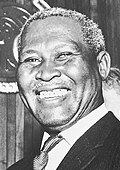
 Union of South Africa
Explanation
Albert John Lutuli was a leader who worked to end unfair rules that separated people by skin color in South Africa. Those rules were called apartheid, and they even forced children to attend different schools and sit in different buses. Lutuli did not fight with weapons; instead, he led marches and sang protest songs to say “Stop the unfairness.” The whole world noticed his bravery and gave him the Nobel Peace Prize. He reminds us that caring about others and treating everyone kindly is important, even in our everyday lives.
Related Keywords
apartheid
Apartheid was the legally enforced system of racial segregation that dominated South Africa from 1948 until the early 1990s. The white minority government classified the population into ‘white, coloured, Indian and black’ groups and regulated where each could live, study, receive medical care or even whom they could marry. Black Africans were denied land rights and the franchise and were forced into impoverished Bantustans. Economically, apartheid locked black citizens into low-wage positions, enabling whites to monopolise capital accumulation. From the 1950s on, domestic resistance and international condemnation grew, leading to UN sanctions and cultural and sports boycotts. The system finally collapsed with the 1994 all-race elections and Nelson Mandela’s inauguration.
non-violent resistance
Non-violent resistance seeks social change without the use of weapons, employing strikes, boycotts, sit-ins and protest marches. Lutuli, drawing on Christian ethics and Gandhian philosophy, adapted this approach to South Africa’s racial context. Non-violence offers moral high ground and attracts international sympathy, while raising repression costs and eroding regime legitimacy. The strategy aligns with Gene Sharp’s theory that political power rests on subjects’ consent rather than coercion. Countless movements, from civil rights in the United States to contemporary climate activism, have replicated this model.
African National Congress (ANC)
Founded in 1912, the ANC is South Africa’s oldest black political organisation. It initially relied on petitions and court actions but shifted toward direct action in the 1940s, culminating in Lutuli’s 1952 election as president. The ANC’s Freedom Charter proclaimed a vision of a multi-racial democracy and fostered alliances with the PAC and the South African Communist Party. After heavy repression in the 1960s, the organisation operated underground and established exile offices in Lusaka and London. Legalised in 1990, it fielded Nelson Mandela as presidential candidate and remains South Africa’s governing party.
racial segregation policy
A racial segregation policy is any legal or administrative regime that separates populations according to race. Apartheid is the paradigmatic case, but U.S. Jim Crow laws and colonial pass systems fall under the same umbrella. Segregation justifies unequal distribution of public resources and blocks political participation of targeted groups. Because discriminatory education, housing and voting restrictions are reproduced across generations, structural inequalities often persist even after legal repeal. Internationally, such policies are recognised as serious human-rights violations under treaties like the International Convention on the Elimination of All Forms of Racial Discrimination and the Rome Statute.
Sharpeville Massacre
On 21 March 1960 in Sharpeville, South Africa, police opened fire on black demonstrators protesting the Pass Laws, killing 69 and injuring more than 180. The massacre shocked the nation and the world; the government declared a state of emergency and banned the ANC and PAC. Conversely, it pushed the UN Security Council to place South Africa on its formal agenda and intensified calls for economic sanctions. The date is now commemorated as the UN International Day for the Elimination of Racial Discrimination and, in post-apartheid South Africa, as Human Rights Day. The event symbolises the state violence faced by non-violent movements and is widely regarded as a turning point toward armed resistance.
Nobel Peace Prize
The Nobel Peace Prize, established by Alfred Nobel’s will, is awarded to individuals or organisations that have made outstanding contributions to fraternity among nations, disarmament or the promotion of peace congresses. Founded in 1895, it is selected by the Norwegian Nobel Committee. Uniquely among the Nobel Prizes, its ceremony is held in Oslo rather than Stockholm. Laureates receive a gold medal, diploma and cash award, attracting global attention. Lutuli’s 1960 prize was the first awarded to an African, spotlighting South Africa’s struggle on the world stage.