1961 Nobel Peace Prize
Reason for Award
for developing the United Nations into an effective and constructive international organization, capable of giving life to the principles and aims expressed in the UN Charter
Laureates
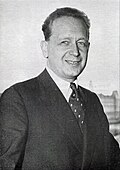
 Sweden
Explanation
Dag Hammarskjöld worked so that people around the world could get along. He was the leader of a team of countries called the United Nations. At the United Nations, he helped countries that were fighting to talk and make peace. Hammarskjöld even sent soldiers wearing blue helmets to stop the fighting without taking sides. This idea is called a “peace-keeping mission.” He treated everyone fairly and tried hard to help those in trouble. Because of these efforts, he received the Nobel Peace Prize.
Related Keywords
United Nations
The United Nations is an international organization founded in 1945 after World War II. Its primary goals are to maintain international peace and security, foster friendly relations among nations, and solve economic and social problems. With more than 190 members, it comprises almost every sovereign state. Decisions are taken through several principal organs such as the Security Council, General Assembly, and ECOSOC. The Secretary-General heads the independent Secretariat and serves as the public face and chief mediator of the organization. Today, the UN provides the platform for peace-keeping missions, the Sustainable Development Goals, and many other global initiatives.
United Nations Peace-Keeping Operations
United Nations Peace-Keeping Operations (PKOs) are multinational forces that monitor cease-fires, assist elections, and deliver humanitarian aid. The first formal PKO was UNEF, created during the 1956 Suez Crisis. Troops are contributed voluntarily by member states, and neutrality plus host-country consent are core principles. After the Cold War, mandates expanded to include civilian protection and state-building tasks. While PKOs enjoy high political legitimacy, they face challenges such as limited budgets, inadequate equipment, and ambiguous missions.
Secretary-General
The UN Secretary-General is the head of the Secretariat and the highest-ranking international civil servant. The term of office is five years, and re-election is possible, though by convention limited to two terms. The Secretary-General can bring matters endangering peace to the Security Council and uses quiet diplomacy to prevent conflicts. Hammarskjöld emphasized the office’s independence and greatly widened its scope for action. Successive Secretaries-General issue speeches and reports that shape global public opinion and provide moral leadership. At the same time, they must balance political pressures from member states with budget constraints.
UN Charter
The UN Charter was signed in 1945 and binds member states as a treaty under international law. Comprising a preamble and 19 chapters, it sets out foundational principles such as the prohibition of force and respect for human rights. Chapter VI provides for pacific settlement of disputes, whereas Chapter VII authorizes enforcement measures against threats to peace. Hammarskjöld invoked Articles 99 and 100 to exercise the Secretary-General’s independence and right of initiative. The Charter remains the constitutional document of the international organization system, and its interpretation is the subject of ongoing debate.
Congo Crisis
The Congo Crisis erupted shortly after Belgian Congo gained independence in 1960, creating political and military turmoil. The mineral-rich Katanga Province declared secession, plunging the country into civil war. In the context of the Cold War, major powers including the US and USSR intervened, complicating the situation internationally. The UN dispatched ONUC to monitor cease-fires, deliver humanitarian aid, and, unusually, to use force against foreign mercenaries. Secretary-General Hammarskjöld died in a plane crash while travelling to mediate, highlighting the tragedy of the conflict. ONUC was the first PKO to conduct large-scale ground and air combat operations, sparking debates about its legal legitimacy. The crisis is studied as a turning point in African Cold War history and in the evolution of UN peace-keeping.