1990 Nobel Peace Prize
Reason for Award
for his leading role in ending the Cold War, signing the Intermediate-Range Nuclear Forces Treaty, and encouraging democratization in the Eastern Bloc through Perestroika
Laureates
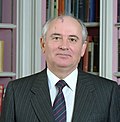
 Soviet Union
Explanation
Mikhail Gorbachev was the leader of a huge country called the Soviet Union. Long ago the world was tense because of the “Cold War,” a type of silent fight between the United States and the Soviet Union. Gorbachev said, “Let’s stop fighting,” and made an agreement with the United States to reduce dangerous nuclear missiles. He also started “Perestroika,” a reform that let people speak and think more freely. Because of this, other Eastern European countries became free without war. These big steps toward peace earned him the Nobel Peace Prize.
Related Keywords
Cold War
The political and military rivalry between the United States and the Soviet Union from the end of World War II until about 1991. Although direct warfare was avoided, nuclear arms races, proxy wars and information battles unfolded worldwide.
Perestroika
The “restructuring” reforms led by Gorbachev in the late 1980s aiming to introduce market mechanisms, broaden political participation and improve administrative efficiency, thereby correcting rigidities in the Soviet socialist system.
Glasnost
A policy meaning “openness” that expanded freedom of speech and media transparency, disclosing government information to citizens to enhance political trust and policy effectiveness.
Intermediate-Range Nuclear Forces Treaty
A 1987 U.S.–Soviet treaty that eliminated all ground-launched ballistic and cruise missiles with ranges between 500 and 5,500 km, pioneering strict reciprocal inspections.
Eastern European Revolutions
The largely non-violent democratic movements around 1989 in Czechoslovakia, Poland, Hungary and other states. Facilitated by the Soviet non-intervention stance, socialist governments collapsed one after another.
Nuclear disarmament
International efforts to reduce, halt and ultimately abolish nuclear weapons. Treaties such as the INF and START serve as milestones.
Fall of the Berlin Wall
On 9 November 1989 East Germany opened its borders and citizens dismantled the Wall, a symbolic event marking the end of the Cold War.
Dissolution of the Soviet Union
In December 1991 the USSR formally dissolved into 15 independent republics. The Cold War structure collapsed, triggering major geopolitical and economic realignments.
Détente
A period of eased U.S.–Soviet tensions in the 1960s-70s marked by SALT talks and multilateral diplomacy but disrupted by the Soviet invasion of Afghanistan. A second détente effectively resumed under Gorbachev.
Strategic Arms Reduction Treaty (START)
U.S.–Russian treaties aimed at reducing long-range nuclear arms. START I, signed in 1991, significantly limited delivery systems and warheads, expanding the arms-control architecture beyond the INF.