1903 Nobel Prize in Chemistry
Reason for Award
for his electrolytic theory of dissociation
Laureates
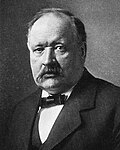
 Sweden
Explanation
When you put salt in water, the water tastes salty and can conduct electricity. Arrhenius was the first person to explain this clearly. He thought that substances like salt, called “electrolytes,” break up into tiny particles called ions when they dissolve. Because there are positive and negative ions moving separately, electricity can pass through the water. This idea helps us understand batteries and even seawater. Today it is taught in science class as something obvious, but Arrhenius was the one who discovered how it works.
Related Keywords
electrolyte
An electrolyte is a substance that dissociates into ions in water or another solvent, allowing the solution to conduct electricity. Typical examples include sodium chloride, sulfuric acid, and potassium chloride. Strong electrolytes ionize almost completely, whereas weak electrolytes ionize only partially. Arrhenius defined electrolytes through their conductivity and examined their behavior in dilute solutions. His theory enabled a systematic understanding of the concentration and temperature dependence of electrolytes, paving the way for modern battery technology and analyses of bioelectrical phenomena.
ionization (dissociation)
Ionization is the process by which molecules split into charged ions in a solvent. Arrhenius treated this process as a reversible chemical equilibrium and showed that dilution increases the number of ions. The degree of dissociation α is defined as the ratio of ions formed to the total number of particles and can be obtained from conductivity measurements. The later Debye–Hückel theory incorporated ion–ion interactions, providing corrections for higher concentrations. The concept of ionization is indispensable for understanding acid–base mechanisms and electrical signaling in living organisms.
ion
An ion is an atom or molecule carrying a positive or negative charge. In the late 19th century, scientists debated whether electric charge was continuous or discrete. Arrhenius’s work, by matching conductivity data with Faraday’s constant, supported the idea that ions carry integer multiples of a fundamental charge. This linked the concept of valence with charge quantization and stimulated the development of chemical bonding theory. Today ions are key to processes ranging from batteries and ocean chemistry to nerve transmission.
osmotic pressure
Osmotic pressure is the force driving solvent flow across a semipermeable membrane and is proportional to the number of solute particles. Van ’t Hoff derived the gas-law-like equation π = CRT, but measured values for electrolyte solutions were larger than predicted. Arrhenius explained this by noting that each electrolyte molecule produces multiple ions, effectively increasing the particle count. This resolved the anomaly in colligative properties and unified solution chemistry. The concept of osmotic pressure is applied in cell water regulation and the formulation of medical intravenous solutions.
molar conductivity
Molar conductivity is the conductivity of an electrolyte solution per unit concentration, defined as Λ_c = κ/c. Arrhenius observed that Λ_c increases with dilution and introduced the infinite-dilution limit Λ_∞. This limit equals the sum of individual ionic mobilities and led to Kohlrausch’s law for separating ionic contributions. Measuring molar conductivity helps estimate ionic radii and solvation structures. It remains an important parameter in evaluating ionic liquids and fuel-cell electrolytes.
Arrhenius acid–base theory
Arrhenius defined an acid as a substance that produces H⁺ in aqueous solution and a base as one that produces OH⁻. The definition is based on ion formation and explains neutralization as the combination of H⁺ and OH⁻. Although narrower in scope than later Brønsted–Lowry or Lewis theories, it was the first comprehensive framework to introduce an electrochemical viewpoint. It remains a simple classification widely taught in schools and used in industrial analysis. The theory paved the way for quantitative discussions of pH and acid dissociation constants.