1904 Nobel Prize in Chemistry
Reason for Award
for the discovery of the inert gaseous elements in air and the determination of their place in the periodic system
Laureates
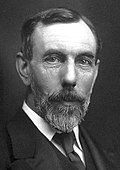
 United Kingdom of Great Britain and Northern Ireland
Explanation
The air we breathe contains not only oxygen and nitrogen but also tiny amounts of mysterious "sleepy" gases that hardly react with anything. These gases do not burn and almost never join with other substances, so they seem very calm. British chemist Sir William Ramsay cooled air until it became a liquid and carefully separated it at different temperatures, discovering these calm gases. He then studied the colors of the light they gave off and confirmed that several completely new gases, such as neon and xenon, existed. Ramsay’s discovery helped make the classroom "table of elements" more complete and greatly changed the world of chemistry.
Related Keywords
noble gases
Noble gases refer to helium, neon, argon, krypton, xenon and radon, the very unreactive monatomic gases in group 18 of the periodic table. Their outer electron shell is closed (s2p6), so they barely take part in chemical reactions. They are used as coolants, in lighting, in gas lasers and in ion propulsion systems, and they serve as tracers in geoscience and astrophysics. Before Ramsay’s work the far-right column of the periodic table was empty, leaving a gap in our understanding of periodicity. Identification of noble gases proved the universality of the periodic law and provided crucial experimental support for the electron-shell model that underpins quantum chemistry.
periodic law
The periodic law states that when elements are arranged by increasing atomic number, their properties repeat at regular intervals; it was systematized by Mendeleev. Until the late 19th century, the absence of noble gases left several periods asymmetric and unexplained. Ramsay’s discovery added group 18, allowing each period to run smoothly from an alkali metal to a noble gas. This completion was later given theoretical support by Bohr’s atomic model and the concept of quantum numbers. The periodic law remains an indispensable foundation for exploring new elements and designing materials today.
fractional distillation of liquid air
Fractional distillation of liquid air exploits differences in boiling points to separate nitrogen (−196 °C), oxygen (−183 °C), argon (−186 °C) and trace components. Cryogenic equipment invented in the late 19th century made it possible to handle large volumes of liquid air. Ramsay used this technique to remove oxygen and nitrogen, then carried out even slower distillation to concentrate the higher-boiling noble gases. Today the same principle is employed in industrial gas supply and in producing high-purity oxygen and nitrogen for semiconductor fabrication. Design of distillation columns is also a classic application of thermodynamics and heat transfer in chemical-engineering education.
spectroscopic analysis
Spectroscopic analysis measures the wavelengths of light emitted or absorbed by a substance and identifies elements or molecules from their characteristic line spectra. Because each element has unique electron transition energies, the spectrum acts as an optical fingerprint. Ramsay applied high-voltage discharge to gaseous samples and used a prism spectroscope to record unknown bright lines, thus confirming new elements. Today spectroscopy is a fundamental tool in astronomy for determining stellar composition and in materials science for detecting impurities. Coupled with lasers or mass spectrometry, it now enables femtosecond time resolution and even single-atom measurements.
ionization energy
Ionization energy is the energy required to remove an electron from an atom to form a positive ion, and it strongly influences chemical reactivity. Noble gases have very high ionization energies because their outer shells are completely filled, explaining their inertness; helium, for example, has the highest first ionization energy at 24.6 eV. In Ramsay’s era such quantities were difficult to measure, but the chemical inertness he observed was later rationalized in terms of ionization energy. Today the concept is applied in plasma physics, semiconductor device design, and studies of laser-generated ions.