1906 Nobel Prize in Chemistry
Reason for Award
for his investigation and isolation of the element fluorine and the development of the electric furnace that bears his name
Laureates
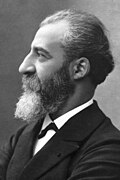
 France
Explanation
1. Fluorine, the element used in toothpaste, was once very hard to get by itself. 2. Henri Moissan used a method called electrolysis—running electricity through chemicals—to be the first person to isolate pure fluorine. 3. He also built a special oven called the Moissan electric furnace that could heat powders to extremely high temperatures. 4. Instead of using fire, his furnace used electricity to reach thousands of degrees, letting scientists try experiments that normal ovens could not handle. 5. Thanks to these inventions, people could study new metals and even the building blocks of gems, pushing science forward.
Related Keywords
fluorine
Fluorine, element symbol F and atomic number 9, is a halogen that exists as a pale yellow toxic gas at room temperature. In the Earth’s crust it occurs mainly as minerals such as calcium fluoride, and as a free element it is too reactive to be found in nature. Industrially it is essential for aluminium smelting and as a precursor to high-performance refrigerants. It is also the source of fluoride ions used in dentistry to prevent tooth decay. Before Moissan’s isolation, repeated explosions and poisonings earned it the nickname “the devil’s element.” Modern fluorine industry and organofluorine chemistry would be inconceivable without its successful isolation.
electrolysis
Electrolysis is a technique that uses electric current to break chemical bonds, producing substances at the anode and cathode. It is widely used for sodium production, water splitting, and many other processes, driving 19th-century electrochemistry. In fluorine isolation, any water would generate oxygen and ozone, heightening explosion risks, so strictly anhydrous conditions were essential. Moissan electrolyzed cold, water-free liquid HF and maintained high current density with platinum-iridium electrodes, achieving success. His work stands as a classic demonstration of solvent choice and safety management in electrolysis process design.
Moissan electric furnace
The Moissan electric furnace creates an arc discharge between graphite electrodes, achieving temperatures above 3,500 °C. It can sustain far higher temperatures than flame furnaces, revolutionizing the synthesis of high-melting compounds such as carbides and nitrides. Graphite walls provide excellent thermal conductivity and heat resistance while maintaining a reducing atmosphere. The design became the prototype for later electric arc and plasma furnaces and was even applied to early synthetic diamond research. Modern carbon-arc methods and ultra-hard material manufacturing owe much to this pioneering furnace.
halogen elements
Halogens are the group-17 elements — fluorine, chlorine, bromine, iodine and astatine — literally meaning “salt formers.” They readily form monovalent anions and exhibit strong oxidizing or disinfecting properties. Fluorine is the most electronegative member, reacting violently with nearly all other elements. Chlorine disinfection and iodine medicines illustrate their daily importance. Moissan’s isolation of fluorine solved the toughest problem in halogen chemistry.
fluoride compounds
Fluorides are compounds in which fluorine bonds with other elements; they serve as fluxes in aluminium smelting and as electrolytes in high-performance lithium batteries, among many uses. Sodium fluoride strengthens tooth enamel and has improved public health. Some fluorides are highly toxic, requiring careful handling. The successful isolation of fluorine allowed fluoride chemistry to be studied systematically. Recently, fluoride nanoparticles have attracted attention for their luminescence and as solid electrolytes.
high-temperature metallurgy
High-temperature metallurgy encompasses material processes above about 2,000 °C for producing steels and specialty alloys. By adding elements such as carbon or calcium and controlling intermetallic phases, desired strength and corrosion resistance can be obtained. The Moissan furnace opened temperature ranges previously unreachable, pioneering research into superalloys containing chromium or vanadium. Later technologies like electroslag remelting and plasma melting follow this lineage. The field laid the groundwork for materials used in jet engines and rocket nozzles.
synthetic diamond synthesis
Diamond forms when carbon crystallizes under extreme pressure and temperature. Moissan experimented by dissolving carbon in molten iron inside his electric furnace and quenching it rapidly, reporting tiny diamond-like crystals. Modern synthetic diamond production became industrially feasible only after the development of ultra-high-pressure apparatus, yet Moissan’s work was a pioneering attempt. Today’s chemical vapour deposition (CVD) and high-pressure high-temperature (HPHT) methods evolved from ideas he first explored. Synthetic diamonds now serve in applications from abrasives to quantum sensors.