1908 Nobel Prize in Chemistry
Reason for Award
for his investigations into the disintegration of the elements and the chemistry of radioactive substances
Laureates
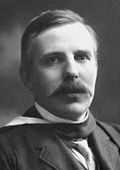
 United Kingdom of Great Britain and Northern Ireland,
  New Zealand
Explanation
Everything around us is made of tiny building blocks called atoms. Rutherford was the first scientist to prove that an atom can sometimes “break” and change into another kind. When an atom breaks, invisible bits of energy called radiation shoot out. He used special paper and screens that sparkled when the radiation hit them, so he could see the invisible. Thanks to this discovery, we now use radiation to treat illnesses and make paint that glows in the dark. Rutherford’s work was the very first step in the adventure of understanding how atoms work.
Related Keywords
radioactivity
Radioactivity is the property of an atomic nucleus to decay spontaneously and emit particles or electromagnetic waves. Rutherford separated and measured radioactivity chemically, classifying it into α, β, and γ rays. Research on radioactivity has led to understanding nuclear energy, radiation therapy, and cosmic rays. A portion of Earth’s internal heat comes from the decay of long-lived radionuclides, making radioactivity important in geology. Today radioactivity is employed not only as an energy source but also in material inspection and medical diagnostics.
transmutation of elements
Transmutation is the change of one element’s nucleus into that of another, scientifically realizing what alchemy once imagined. Rutherford observed the N(α,p)O reaction—nitrogen struck by α particles producing oxygen and protons—showing the first man-made transmutation. The discovery strengthened the concept of atomic number and established the notation of nuclear reaction equations. Modern nuclear-fusion studies and transmutation of long-lived radioactive waste are practical outgrowths of this idea. As basic science, transmutation is key to understanding nuclear structure and Coulomb barriers.
alpha particle
An alpha particle is the nucleus of helium-4, consisting of two protons and two neutrons. Rutherford’s alpha-scattering experiments allowed him to infer the existence and size of the atomic nucleus. Because alpha particles carry positive charge and ionize matter strongly, they are exploited in certain radiation therapies. Their range is only a few centimeters in air, so internal exposure is more dangerous than external exposure. Modern alpha spectroscopy is widely used in nuclear-physics experiments and environmental monitoring.
half-life
Half-life is the time required for half of the atoms in a radioactive sample to decay. Rutherford and Soddy showed that decay follows an exponential law and derived T1/2=ln2/λ. The concept is indispensable for age dating, selecting medical isotopes, and managing radioactive waste. Nuclides with short half-lives release intense radiation quickly, making them useful in therapy and diagnostics. Long half-life nuclides pose significant challenges for environmental protection and safety management.
atomic nucleus
The atomic nucleus is the dense central region of an atom where protons and neutrons are bound together. Rutherford’s scattering work first made its existence clear. With a diameter of about 10^−15 meters, the nucleus is tiny compared to the whole atom, yet it contains nearly all of the atom’s mass. Studies of nuclei led to the discoveries of fission and fusion reactions, which serve as powerful energy sources. Nuclear physics is closely linked to particle and astrophysics, helping clarify the origins of matter and the universe.
Rutherford model
The Rutherford model is an early atomic structure model with a central nucleus surrounded by orbiting electrons. It was derived from the 1911 gold-foil scattering experiment and showed that atoms are mostly empty space. The model evolved into the Bohr and quantum-mechanical models, forming the basis of today’s view of the atom. Although it could not explain electron arrangements, it was crucial in establishing the reality of the nucleus. Modern textbooks still present the Rutherford model as the first step in learning atomic structure.