1909 Nobel Prize in Chemistry
Reason for Award
in recognition of his work on catalysis and for his investigations into the fundamental principles governing chemical equilibria and rates of reaction
Laureates
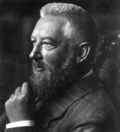
 German Empire
Explanation
Chemical reactions take place around us every day; for example, milk turning sour is one. Ostwald studied why some reactions move quickly while others are slow. He found that special helpers called catalysts can make reactions run much faster. He also measured the point where a reaction comes to rest, a state called chemical equilibrium. By carefully experimenting, he explained how these processes work. Thanks to his findings we make medicines and fertilizers much more efficiently today.
Related Keywords
catalysis
Catalysis is the phenomenon of greatly changing the rate of a chemical reaction without altering the final equilibrium composition. A catalyst provides an alternate pathway with lower activation energy. Industrial processes employ metal catalysts such as platinum and nickel for ammonia synthesis, hydrogenation and many other reactions. In living organisms, proteins called enzymes serve as catalysts, enabling life’s chemistry to proceed rapidly under mild conditions. Mastering catalysis is key to improving energy efficiency and reducing environmental impact.
chemical equilibrium
Chemical equilibrium is the state in which the rates of the forward and reverse reactions become equal, so the composition remains unchanged macroscopically. Ostwald emphasized that equilibrium is "dynamic," not static, with molecules continuously reacting in both directions. The equilibrium constant K depends only on temperature and is related to the standard Gibbs free energy change ΔG° by −RT ln K. According to Le Chatelier’s principle, changing conditions like pressure or temperature shifts the equilibrium, allowing control over product yield. The concept of chemical equilibrium finds applications from synthetic chemistry to metabolism and geochemistry.
reaction rate
Reaction rate expresses how much concentration or amount of a substance changes per unit time and is directly linked to industrial process design. Ostwald introduced rate laws and defined reaction order based on concentration dependence. The temperature dependence is described by the later Arrhenius equation, leading to the concept of activation energy. Measurement techniques include colorimetry, conductivity, and spectroscopic methods, chosen according to the reaction type. Kinetic studies underpin catalyst development, environmental remediation, combustion control, and many other fields.
law of mass action
The law of mass action states that the reaction rate is proportional to the product of the reactant concentrations. Proposed by van ’t Hoff and Guldberg, it was quantitatively confirmed by Ostwald’s experiments. The law is also used to derive equilibrium constants and is the starting point for predicting equilibrium compositions. In non-ideal systems, activities must be introduced, linking the law to thermodynamic activity coefficients. The law of mass action is fundamental to chemical reaction network analysis and even systems biology models.
Ostwald dilution law
The Ostwald dilution law connects the degree of dissociation α of a weak electrolyte with its concentration C through K_d = α^2 C / (1 − α). By measuring conductivity as a solution is diluted, one can determine the dissociation constant and thus compare the strengths of acids and bases. At the end of the 19th century, when electrolyte theory was still immature, this law bridged equilibrium theory and electrochemistry in a breakthrough achievement. Deviations at higher concentration, where ion pairing and electrostatic interactions are significant, paved the way for the later Debye–Hückel theory. Even today the law is frequently covered in basic analytical chemistry laboratories and supports the construction of constants databases.