1918 Nobel Prize in Chemistry
Reason for Award
for the development of the ammonia synthesis method (Haber-Bosch process)
Laureates
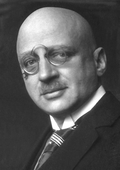
 German Empire
Explanation
There is a lot of a gas called “nitrogen” in the air, but plants cannot use it directly. Fritz Haber found a way to mix this nitrogen with hydrogen to make a new substance called “ammonia.” Think of a giant kitchen where the mixture is cooked under very high temperature and pressure. The ammonia becomes the main ingredient of fertilizers and helps farmers grow more food. Because of this invention, fewer people go hungry around the world.
Related Keywords
ammonia
Ammonia (NH₃) is a colorless gas with a strong, pungent odor. It is highly soluble in water and alkaline, so it is used in cleaners and refrigeration. It serves as a precursor for fertilizers, explosives, pharmaceuticals, and many other chemicals, making it one of the most extensively produced compounds worldwide. Very little occurs naturally in the atmosphere; most is synthesized via the Haber-Bosch process. Research is now exploring its role as a hydrogen carrier and carbon-free fuel.
Haber-Bosch process
The Haber-Bosch process is the industrial route to synthesize large quantities of ammonia from nitrogen and hydrogen. Haber achieved the laboratory breakthrough in 1909, and Bosch industrialized it by developing high-pressure equipment and heat-resistant steels. The reaction proceeds over an iron catalyst at high temperature and pressure, with continuous recycle of unreacted gases to improve efficiency. This technology drastically increased global food production and reshaped human history. However, it is energy-intensive and CO₂-emitting, so greening the process is a major challenge.
nitrogen fixation
Nitrogen fixation converts inert atmospheric nitrogen (N₂) into forms usable by living organisms or industry. In nature it occurs via lightning and nitrogen-fixing bacteria, but the amounts are limited. The Haber-Bosch process enabled artificial nitrogen fixation, supplying vast quantities of nitrogen to agriculture as fertilizer. Today roughly half of the fixed nitrogen on Earth is of industrial origin. Managing its impact on the nitrogen cycle and the environment is a 21st-century challenge.
catalyst
A catalyst speeds up a chemical reaction without being consumed. In the Haber-Bosch process, iron is the main catalyst, with potassium and alumina acting as promoters. Catalysts lower activation energy and thus greatly reduce the energy required by industrial processes. Their activity depends on nanoscale features such as surface area and electronic structure, making precise design crucial. Developing more efficient and eco-friendly catalysts is key to lowering environmental impact.
chemical fertilizer
Chemical fertilizers are factory-made products that supply nutrients such as nitrogen, phosphorus, and potassium to plants. Ammonia is converted into nitric acid or urea and used as fast-acting nitrogen fertilizer. Before the 20th century, nitrogen was mainly obtained from bird guano, but the Haber-Bosch process vastly expanded supply. While chemical fertilizers underpin global food production, they also contribute to water pollution and greenhouse gas emissions. Sustainable use through balanced application and smart agriculture is essential.
industrial chemistry
Industrial chemistry conducts chemical reactions on a large scale to efficiently produce materials society needs. The Haber-Bosch process is an early landmark that united high-pressure engineering, catalysis, and materials science. A systems approach that includes process optimization and energy recovery is essential. Today the field is transitioning toward green chemistry that addresses climate change and resource recycling. Innovative processes and renewable feedstocks are required to balance industry with environmental stewardship.