1925 Nobel Prize in Chemistry
Reason for Award
for his demonstration of the heterogeneous nature of colloid solutions and for the methods he used, which have since become fundamental in modern colloid chemistry
Laureates
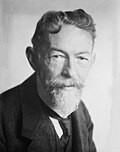
 German Reich,
  Kingdom of Hungary
Explanation
Milk and mayonnaise look like single liquids, but they are actually tiny particles floating in water; this special state is called a colloid. Mr. Zsigmondy built a special microscope that allowed scientists to see those tiny particles for the first time. Thanks to his work, we can now explain everyday mysteries such as why milk stays mixed and looks white.
Related Keywords
colloid solution
A colloid solution is a system in which particles roughly 1–1000 nanometres in size are uniformly dispersed in a liquid. Although gas or solid dispersions also exist, liquid colloids are the most common. Because the particles are so small, they do not settle under gravity but exhibit Brownian motion, giving the mixture an apparently homogeneous appearance. The particles scatter light, making the system visible via the Tyndall effect. Colloids are used in food, cosmetics, and pharmaceuticals, where controlling particle size directly determines performance.
ultramicroscope
The ultramicroscope, invented by Zsigmondy in 1902, uses dark-field observation perpendicular to the illumination path. By detecting only scattered light, it can visualize nanoparticles smaller than the diffraction limit as bright points. This allowed direct confirmation of colloid particles and their motion. The instrument is the ancestor of modern laser scattering and nanoparticle tracking analysis. It revolutionised stability evaluation and size measurement of particle dispersions.
Brownian motion
Brownian motion is the random movement of small particles caused by collisions with surrounding molecules. Zsigmondy recorded the Brownian motion of gold particles using the ultramicroscope, demonstrating agreement between theory and experiment. The observation served as key evidence for the existence of molecules. It is used to verify the Stokes–Einstein relation linking diffusion coefficient and particle size. Brownian motion underpins dynamic light scattering and microrheology of nanoparticles.
dialysis (chemistry)
In chemistry, dialysis is a separation technique that removes small molecules through a semipermeable membrane while retaining larger colloid particles. Zsigmondy repeatedly dialysed colloidal solutions to purify them and quantify the effect of electrolytes on particle stability. Today, dialysis is used in protein purification and post-processing of drug-delivery particles. Clean colloids obtained by dialysis improve reproducibility in light-scattering and viscosity measurements. Development of membrane materials has also led to medical hemodialysis and industrial wastewater treatment applications.
Tyndall effect
The Tyndall effect is the visible light path produced when colloid particles scatter light. It is the same principle that makes a flashlight beam visible in fog. Zsigmondy used the effect to measure particle size and concentration, demonstrating colloidal heterogeneity. Environmental science applies it to detect atmospheric aerosols, and food science uses it to assess beverage turbidity. Analysis of wavelength-dependent scattering intensity has evolved to estimate particle size distributions.
particle size distribution
Particle size distribution represents the statistical spread of sizes in a dispersion. The stability and optical properties of a colloid depend not only on mean size but also on the distribution shape. Zsigmondy’s work led to preparation methods yielding narrow distributions, applied today in high-performance pigments and quantum-dot production. Modern techniques such as dynamic light scattering and electrophoretic mobility analysis evaluate nanoparticle distributions. Controlling the distribution is crucial for drug-release rates and ink-jet printing accuracy.
sol–gel transition
The sol–gel transition is the process in which a liquid sol forms a three-dimensional network and becomes a solid gel. As colloid particles aggregate and cross-link, viscosity rises sharply until solidification occurs. Zsigmondy’s particle-observation techniques provided a means to visualise this transition point. The phenomenon underlies the manufacture of ceramics, silica aerogels, contact-lens materials, and many other technologies. By controlling the transition, engineers can design pore size and mechanical strength of the final material.
heterogeneous system
A heterogeneous system contains two or more distinct phases—solid, liquid, or gas. Although a colloid appears to be a single phase, it is actually a classic heterogeneous system comprising particle and solvent phases. By demonstrating this heterogeneity, Zsigmondy opened pathways to thermodynamic and interfacial chemistry research. Understanding surfactants and emulsion stabilisation also relies on the concept of heterogeneous systems. Materials development often seeks to control heterostructure to optimise optical and mechanical properties.