1961 Nobel Prize in Chemistry
Reason for Award
for his research on the carbon dioxide assimilation in plants
Laureates
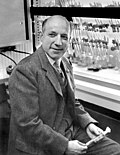
 United States of America
Explanation
The vegetables we eat and the trees in the forest grow by using sunlight in a process called “photosynthesis.” During photosynthesis, carbon dioxide from the air and water from the soil are turned inside leaves into sugary food for the plant. Dr. Melvin Calvin wanted to know the exact path these ingredients take while changing inside the leaf. He put a special “label,” like invisible ink, on carbon dioxide and followed its journey through the plant. Thanks to his work, we now understand better how plants clean our air and provide us with food and oxygen.
Related Keywords
photosynthesis
Photosynthesis converts light energy into chemical energy and fixes inorganic carbon into organic molecules. It is performed by green plants and cyanobacteria and produces most of the Earth’s oxygen. The reactions are broadly divided into photochemical (light) reactions and the Calvin cycle (dark reactions). Studies on its efficiency and light-harvesting systems inspire the design of solar cells and artificial photosynthesis devices. In the context of climate change, CO2 uptake by photosynthesis acts as a key regulator of the global carbon cycle.
Calvin–Benson cycle
The Calvin–Benson cycle uses ATP and NADPH from the light reactions to convert CO2 into organic compounds. It operates primarily in C3 plants and produces 3-phosphoglycerate as the first stable intermediate. The cycle is organized into carboxylation, reduction, and RuBP regeneration phases, with RuBisCO as the key first enzyme. Photorespiration, caused by oxygen competing with CO2, is a major factor lowering the efficiency of this cycle. Genetic engineering and synthetic biology aim to optimize this pathway to boost crop productivity and valorize CO2.
carbon fixation
Carbon fixation is the biochemical conversion of inorganic carbon from the atmosphere or water into organic compounds. Besides photosynthesis, diverse pathways exist, such as the reductive TCA cycle in chemolithoautotrophs and deep-sea vent bacteria. In the global carbon cycle, the balance between fixation and respiratory release influences climate. As massive CO2 emissions pose problems today, artificial fixation technologies and engineered microbial pathways receive growing attention. Calvin’s work provided a decisive blueprint for understanding biological carbon fixation mechanisms.
carbon dioxide isotope labeling
Isotope labeling tracks chemical pathways by incorporating specific isotopes of an element into molecules. Calvin used radioactive isotope 14C in CO2 to detect photosynthetic intermediates with high temporal resolution. This technique experimentally visualized metabolic networks that had previously been only theoretical sketches. Today, stable isotopes such as 13C combined with mass spectrometry enable similar analyses without radioactivity. Isotope labeling is now indispensable across pharmacology, geoscience, and materials research.
chloroplast
The chloroplast is the organelle in eukaryotic cells that carries out photosynthesis, containing thylakoid membranes and stroma. Light reactions occur on the thylakoid membrane, while the Calvin cycle proceeds in the stroma. Chloroplasts originated from cyanobacteria that entered into an endosymbiotic relationship with a host cell, making them primary endosymbiosis-derived organelles. Coordination between plastid and nuclear genomes is essential for synthesizing photosynthetic proteins and assembling membranes. Chloroplast genome engineering is now explored as an efficient gene-delivery and high-yield protein production platform.
carbon cycle in ecosystems
The carbon cycle in ecosystems describes how carbon moves among air, land, and water through processes such as photosynthesis, respiration, decomposition, and sedimentation. Forests and marine plankton act as massive carbon sinks, helping regulate atmospheric CO2 levels. Human combustion of fossil fuels disturbs this balance and drives global warming. Calvin’s elucidation of the carbon fixation pathway allowed key parameterization in ecosystem models. Consequently, Earth system models that predict climate scenarios incorporate Calvin-cycle-based equations for photosynthetic rates.