1973 Nobel Prize in Chemistry
Reason for Award
for their pioneering work, performed independently, on the chemistry of organometallic, so-called sandwich compounds
Laureates
 West Germany
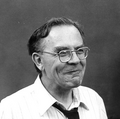
 United Kingdom of Great Britain and Northern Ireland
Explanation
In chemistry, atoms join together to make compounds. When a metal atom holds hands with a molecule that contains carbon, we call it an “organometallic compound.” In 1973 Dr. Fischer and Dr. Wilkinson discovered a very unusual kind of compound. The metal atom is squeezed between two flat rings, so chemists nick-named it a “sandwich compound.” A famous example is ferrocene: an iron atom sits between two circular rings. Because of this shape the molecule is very stable and has a bright orange color. Today, sandwich compounds help us make medicines and electronic materials.
Related Keywords
sandwich compound
A coordination complex in which a metal atom is sandwiched between two planar ligands. It introduced a new bonding motif to organometallic chemistry and is a textbook example of the 18-electron rule. Ferrocene, the archetype, is air-stable and crystallizes as an orange solid. The electronic properties can be tuned easily, so sandwich compounds find applications in catalysis and materials science. They also serve as precursors for semiconductor polymers and bioactive molecules.
organometallic chemistry
The branch of chemistry that studies compounds with direct metal–carbon bonds. By merging metal catalytic properties with the diversity of organic molecules, it opens new reaction pathways. The discovery of sandwich compounds expanded its scope and highlighted the importance of electron counting and ligand design. Today it underpins polymer synthesis, drug manufacture, and energy-conversion catalysis. Synergy with quantum chemical calculations is accelerating molecular design.
ferrocene
A metallocene consisting of an iron atom sandwiched between two η⁵-coordinated cyclopentadienyl rings. It shows reversible redox behavior, serving as a standard electrode material and as a dopant for organic electronic devices. X-ray studies confirmed its parallel Cp rings, making it the prototypical sandwich structure. Derivatization is straightforward, extending applications to medicine, polymers, and electronics. Electronic and steric modifications allow control over chirality and magnetism.
η⁵ coordination
A mode of binding in which five contiguous atoms of a ligand simultaneously attach to a metal center. The cyclopentadienyl ring is the archetype, donating its entire π-electron cloud. This greatly increases the metal’s electron count and helps satisfy the 18-electron rule. Understanding hapticity is key to designing reactivity and catalytic selectivity. Varying the η value can trigger π→σ rearrangements and C–H activation.
coordination chemistry
The study of structures and reactivities of complexes formed by metal ions and ligands. Overlapping with organometallic chemistry, it classifies compounds by coordination number, bonding symmetry, and electron configuration. Sandwich compounds, with their non-classical ligation, expanded the framework of the field. Coordination-chemistry insights are essential for catalyst, material, and bioinorganic design. Advances in spectroscopy and computational chemistry now enable detailed electronic analysis.
cyclopentadienyl anion
An aromatic anion, C₅H₅⁻, containing 6 π-electrons. It is a strong π-donor and binds transition metals in an η⁵ fashion to form metallocenes. It can act as a base, enabling halide abstraction from metal halides. Substitution allows fine tuning of steric and electronic features; Cp* and fluoro-substituted Cp ligands are well known. The Cp ligand is a standard example in electron-counting exercises in chemical education.
π-electron donation
The process in which delocalized π-electrons from an aromatic ring or multiple bond are donated into empty metal orbitals. It increases the electron count at the metal center, strongly affecting bond energies and reaction pathways. In sandwich compounds the Cp rings share their π-electron cloud, driving the metal to an 18-electron closed shell. Donation strength can be tuned by ring substituents and metal electronegativity. It is a key factor in designing catalytic activity and photophysical properties.