1974 Nobel Prize in Chemistry
Reason for Award
for his fundamental achievements, both theoretical and experimental, in the physical chemistry of macromolecules
Laureates
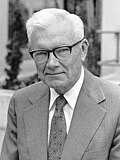
 United States of America
Explanation
Plastic, rubber and even paper are made from very long molecules called polymers. Paul Flory studied in detail how these long molecules change shape and move in water, air and other surroundings. He not only carried out experiments but also invented mathematical rules that predict how polymers mix and stretch. Thanks to his work, we can design strong toys and lightweight sports gear that we use every day. In other words, Flory uncovered the rules of "molecular string play" and helped modern manufacturing.
Related Keywords
polymer
A gigantic molecule composed of thousands to millions of atoms linked in a chain. It is the fundamental unit of plastics, rubber, DNA and many other materials. Flory expressed polymer shape and motion mathematically and clarified their relation to physical properties. His theories underpin the optimization of processing conditions and the design of new materials. The concept remains central in modern biomaterials and nanotechnology.
macromolecule
An academic term synonymous with polymer, referring to extremely large molecules in general. Introduced in the 1930s by Hermann Staudinger, macromolecules possess complex structures and multifunctionality. Flory systematized their physical-chemical properties, bridging experiment and theory. His main achievement was establishing thermodynamic and statistical mechanical frameworks. The term is now widely used in research on proteins as well as synthetic polymers.
Flory-Huggins theory
A lattice-based theory describing the mixing free energy of polymer solutions, enabling predictions of solubility limits and phase separation. Its χ parameter quantifies solvent–polymer interactions. By extending the ideal-gas concept, it shows that entropy contributions from large molecules are small. The theory matches experimental observations and is applied to polymer processing, paint formulation and drug-capsule design. It is also used in extended form to analyze self-assembly of block copolymers.
excluded volume
A steric effect stating that two parts of a molecule cannot occupy the same space simultaneously. In polymer chains it causes the coil to swell, greatly influencing solution size and viscosity. Flory used a simple scaling argument to derive the excluded-volume exponent ν, establishing the law for chain expansion with length. Experiments via light scattering and viscosity confirmed the prediction, making this a cornerstone of many solution theories. The concept is crucial in nanofluid design and studies of biopolymer folding.
random coil
The average tangled shape adopted by a polymer chain in solution. Flory modeled it as a mathematical random walk and computed the coil radius. The random coil concept is indispensable for understanding unfolded proteins and synthetic polymers before glass transition. It is visualized experimentally by small-angle scattering and NMR, and matches molecular simulations. It provides key parameters governing material flexibility and diffusion.
radius of gyration
An indicator of the spatial spread of a polymer’s mass distribution, defined as the square root of the mean-square distance of all monomers from the center of mass. It can be measured directly from the structure factor in light scattering, serving as a bridge between theory and experiment. Flory’s scaling theory yields the relation R_g ∝ N^ν. It allows quantitative evaluation of solvent quality, temperature and branching effects. The parameter is used in designing nanoscale drug carriers and modeling flexible materials.
gel point
The critical point at which an infinite network first appears during crosslinking reactions. Defined by the Flory–Stockmayer relation p_c=1/(f−1), it predicts the boundary where mechanical strength and flow properties change abruptly. Controlling the gel point determines the performance of adhesives and hydrogel medical materials. It is detected by rheology and dynamic light scattering. Recently it has become a key design parameter for resins used in 3D printing.
crosslinking
A chemical reaction that links different polymer chains, indispensable for improving elastomer elasticity and solvent resistance. Flory derived the relation between crosslink density and modulus from free-energy considerations, building rubber-elasticity theory. Industrial applications are broad, including vulcanized rubber and epoxy curing. Excessive crosslinking causes brittleness, so controlling conditions near the gel point is crucial. Recently, environmentally friendly methods using radiation or light-induced crosslinking have been developed.
copolymerization
A reaction in which different monomers polymerize simultaneously, incorporating multiple unit types into the chain. Flory derived composition-distribution equations from instantaneous reactivity ratios, enabling rational material design. Block, graft and random arrangements strongly influence properties. Copolymerization is exploited in products such as ABS resin and thermoreversible adhesives. It is also key to nanostructure control through self-assembly and microphase separation.
theta temperature
A special temperature in a polymer solution where excluded-volume effects cancel and the chain behaves as an ideal coil. Defined in Flory’s theory as the boundary of solvent quality, it corresponds to minima in R_g and viscosity. Measurements near θ allow isolated evaluation of true intermolecular interactions. Thermodynamically it can act as a starting point for phase separation. The concept is important in precise polymer characterization and biopolymer folding studies.