1976 Nobel Prize in Chemistry
Reason for Award
for his studies on the structure of boranes illuminating problems of chemical bonding
Laureates
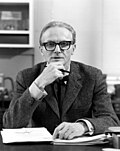
 United States of America
Explanation
Molecules made of the element boron and hydrogen are called boranes. Dr. Lipscomb studied what shapes these tiny molecules have. Like building with toy balls and sticks, he used X-rays to see how the atoms are arranged. He found triangles and other unusual patterns that did not match the pictures in old textbooks. Thanks to his work, scientists learned new rules about how atoms can stick together.
Related Keywords
boranes
Boranes are compounds composed solely of boron and hydrogen, generally denoted BnHm. Because they are electron-deficient, their structures cannot be explained by ordinary two-center, two-electron bonding. Lipscomb showed that they adopt three-dimensional polyhedral frameworks such as deltahedra. These structures became a cornerstone of cluster chemistry and stimulated studies of metal clusters and carboranes. Boranes are also explored as high-energy fuels and as precursors for boron neutron capture therapy (BNCT) agents. They serve as textbook examples for learning about electron-deficient bonding and how chemical bonding theory can be expanded.
electron-deficient bonding
Electron-deficient bonding refers to bond types that cannot be described by the conventional two-center, two-electron model because there are too few valence electrons for the number of atoms present. In boranes, the total valence electrons of B and H are fewer than 2 × (number of atoms − 1), creating this deficit. Concepts such as three-center two-electron and multi-center bonding were introduced to solve the problem, allowing electrons to be shared among several atoms. The idea has been applied to metal clusters, superconducting hydrides, and electronic materials. Grasping electron-deficient bonding generalizes bonding theory and underpins new material design.
three-center two-electron bond
A three-center two-electron (3c-2e) bond involves three atoms sharing two electrons and is characteristic of boranes and some beryllium compounds. In B-H-B units, two boron atoms are linked through a bridging hydrogen. Molecular orbital theory describes one bonding, one non-bonding, and one antibonding combination; occupation of the bonding orbital with two electrons stabilizes the unit. X-ray structures and NMR distance/angle measurements confirm its reality. Lipscomb’s quantitative analysis popularized the concept, profoundly influencing cluster chemistry. Today it is applied in organometallic chemistry and hydrogen-bond network studies.
X-ray crystallography
X-ray crystallography is an experimental technique that determines atomic arrangements by analyzing diffraction patterns produced when X-rays strike a crystal. Lipscomb used then-state-of-the-art four-circle diffractometers and collected data on tiny borane crystals at very low temperatures. The resulting electron-density maps visualized the previously unknown polyhedral boron frameworks. X-ray analysis later became a standard tool for proteins and complex inorganic materials alike. Precise atomic coordinates are indispensable for validating theoretical calculations, serving as a bridge between experiment and theory.
neutron diffraction
Neutron diffraction uses neutron beams to locate atomic nuclei and is especially useful for determining positions of hydrogen and other light elements. Because boranes contain many hydrogens, Lipscomb employed neutron sources to measure B-H bond lengths with high precision. Neutrons carry no charge, so they are not perturbed by electron clouds, giving direct nuclear information. The technique is also invaluable in studies of fuel-cell materials and hydrogen-storage alloys. Combined with X-ray data, it greatly improves the completeness of structural information.
Wade's rules
Wade’s rules are empirical guidelines in cluster chemistry that correlate cluster stability with electron count and polyhedral shape, classifying clusters as nido, closo, arachno, and so on. Lipscomb’s precise structural data were essential for testing and refining these rules. Mingos later extended them to transition-metal clusters. Wade’s rules are pedagogically valuable and serve as design principles for electron-deficient systems.
cluster chemistry
Cluster chemistry deals with molecular clusters containing a few to several tens of atoms. Borane studies marked the starting point of the field, providing the foundation of multi-center bonding and electron-counting rules. Today it spans metal cluster catalysts, quantum dots, nanoparticles, and more. Because of their small size, clusters exhibit quantum properties distinct from bulk materials, blurring boundaries with materials science. Cluster chemistry is therefore valued as a bridge between molecular and solid-state chemistry.
molecular orbital theory
Molecular orbital (MO) theory describes electrons in terms of orbitals spread over the entire molecule, allowing analysis of energy levels and bonding character. Lipscomb used self-consistent-field calculations to quantify three-center orbitals in boranes and achieved excellent agreement with experimental structures. MO theory intuitively explains occupancy of bonding and antibonding orbitals in electron-deficient systems. Consequently, it facilitates predictions of chemical reactivity and design of optical properties. Today MO theory is combined with DFT and ab-initio approaches to analyze electronic states in large molecules and materials.