1907 Nobel Prize in Literature
Reason for Award
in consideration of the power of observation, originality of imagination, virility of ideas and remarkable talent for narration which characterize the creations of this world-famous author
Laureates
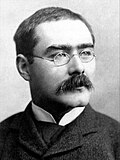
 United Kingdom of Great Britain and Northern Ireland
Explanation
Rudyard Kipling was an English author born in India who wrote stories about adventure and animals. Characters like Mowgli and Baloo the bear from The Jungle Book are loved by children all over the world. Kipling watched the world around him carefully and turned what he saw into lively sentences. The Nobel Prize in Literature praised his sharp observation, rich imagination, and skill in telling stories. When you read his books, you can feel as if you are really in a distant land or time.
Related Keywords
Imperialism
Imperialism refers to the policy by which 19th-century powers economically and militarily dominated overseas territories. Kipling’s works were written at the height of the British Empire and display both an affirmative portrayal of imperial values and implicit critiques. Even his children’s stories carry a gaze toward other cultures that reflects power structures and are closely linked to the idea of the "white man’s burden." Literary scholarship analyzes imperialist representation to uncover mechanisms of discrimination and incorporation embedded in the text. Reading Kipling helps us grasp the historical impact of imperialism and think about today’s international relations and cultural frictions. Such perspectives are indispensable to interdisciplinary debates in postcolonial criticism and comparative empire studies.
Colonial literature
Colonial literature refers to texts produced under colonial rule or dealing with colonial experience. Many of Kipling’s works are set in imperial peripheries such as India or Burma, portraying everyday life and friction in colonial society. Characters’ speech patterns and languages reflect the divide between rulers and subjects, presenting a space where multiple cultures intersect. Studies of the genre examine how the imperial language (English) absorbs and transforms local voices. Digital humanities projects are beginning to create colonial-literature corpora to statistically examine lexical shifts and identity expressions. Kipling is frequently cited as a rich example in these scholarly discussions.
Children's literature
Children’s literature denotes stories and poems written primarily for young readers. Kipling’s works such as The Jungle Book and "Just So Stories" use animals to convey friendship and courage, serving as classic examples. Late-19th-century children’s literature had a dual purpose of entertainment and moral instruction, also functioning as a medium to instill imperial ideology. Scholars analyze story structure, vocabulary choice, and illustrations to investigate the influence on children’s cognitive development and value formation. Today, there is active re-evaluation of Kipling’s works from the standpoints of multicultural education and animal ethics. These debates show that children’s literature is a social apparatus beyond mere reading material.
Short story
A short story is a literary form that completes its narrative within a limited length, condensing themes into a small set of characters and circumstances. Kipling wrote numerous short stories for newspapers and magazines, honing techniques that instantly immerse the reader in the story world. By combining meticulous scene description with brisk dialogue, he achieves deep psychological portrayal within a brief space. His techniques are seen as a bridge to pre-modernist English short fiction, influencing authors such as Joyce and Hemingway. Analyzing short stories provides excellent material for understanding plot structure and shifts in point of view and is applied in creative writing education. Digital analysis of paragraph length and lexical density offers clues to correlations between style and reader cognitive load.
Narrative technique
Narrative technique encompasses the methodological ensemble of time manipulation, viewpoint, narrator, and linguistic rhythm used to construct storytelling. Kipling freely alternates omniscient, limited, and first-person narration, strategically supplying readers with multilayered information. Frequent flashbacks and inserted songs interrupt the narrative flow to heighten emotional resonance. The mixture of rhythmic prose and metrical verse creates a cross-genre reading experience, foreshadowing aspects of later modernist literature. By deliberately unsettling narrative reliability, he encourages critical reading and sometimes hints at imperial contradictions. The examination of narrative technique is gaining attention as a research area bridging literary theory and cognitive science.
The Jungle Book
Published in 1894, The Jungle Book is a collection of short stories that follow the adventures of Mowgli and various animals. Set in the Indian jungle, it has been read as an allegory contrasting human society with the ethics of the natural world. Animal characters are assigned social ranks and laws, repeatedly voiced through "the Law of the Jungle." Nineteenth-century scientific thought and hunting culture form the background, with Darwinian perspectives influencing behavioral portrayals. While beloved as children’s literature, the text is also studied academically for its imperial gaze and environmental ethics. Numerous adaptations, including Disney films, have circulated it globally, making it a subject of cross-cultural reception and media-mix studies.
If—
If— is a four-stanza poem published in 1910 that presents an ideal of maintaining self-control in challenging situations. Its clear and simple English made it widely read, even included for recitation in school curricula. Kipling is said to have modeled the poem on Sir Leander Starr Jameson, a soldier-politician in South Africa. Each line accumulates ideals of self-restraint, patience, and universal morality through parallel syntax, with the meter enhancing its proverbial effect. Cultural studies view it as a text that condenses Victorian masculinity and imperial civic ethics. Conversely, critics note that its stoic values sometimes clash with modern perspectives that emphasize diversity.
Ballad of East and West
The Ballad of East and West, published in 1889, is a narrative poem depicting the friendship between a British officer and an Afghan chieftain. Its famous opening line, "Oh, East is East, and West is West, and never the twain shall meet," hints at cultural difference yet is reversed as the story unfolds. Using the ballad form, the poem recreates oral-literature rhythms while portraying tension and mutual respect on an imperial frontier. Postcolonial critique notes that while the poem presents personal solidarity across colonial hierarchies, it ultimately reaffirms imperial authority. Phonological studies show that its stress patterns and lexical choices link closely to the theme of cultural collision. The work is also cited in border studies and comparative poetics as a model case of intercultural communication.