1913 Nobel Prize in Literature
Reason for Award
because of his profoundly sensitive, fresh and beautiful verse, by which, with consummate skill, he has made his poetic thought, expressed in his own English words, a part of the literature of the West
Laureates
 British Indian Empire
Explanation
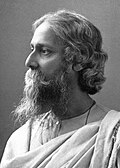
Rabindranath Tagore was a poet born in India. He wrote gentle and beautiful words that warm people’s hearts. Tagore translated many of his Bengali poems into English so that readers all over the world could enjoy them. His collection “Gitanjali,” like a bouquet filled with many short poems, became very famous. Because of its greatness, Tagore became the first Asian to receive the Nobel Prize in Literature.
Related Keywords
Gitanjali
“Gitanjali” is a poetry collection published by Tagore in 1910 whose themes are devotion to the divine and the quest for inner freedom. The English edition appeared in Britain in 1912, introduced by poet W. B. Yeats. Its 70-plus short poems blend Bengali rhythm with concise English, offering readers in both East and West a fresh experience. The book formed the core reason for Tagore’s Nobel Prize. Even today it is retranslated worldwide and remains indispensable in global poetry anthologies.
Bengali language
Bengali is an Indo-Aryan language spoken in eastern India and Bangladesh and was Tagore’s mother tongue. Its rich vowel system and melodic intonation make it highly compatible with oral poetry and song. During the 19th-century Bengal Renaissance, both literary and colloquial registers were standardized through newspapers and education, vastly expanding literary possibilities. Tagore wrote in Bengali and translated himself into English, experimentally displaying poetic energy across languages. His dual-language strategy is often cited in contemporary translation studies.
Bengal Renaissance
The Bengal Renaissance was a cultural movement centered in Calcutta from the mid-19th to early 20th century. It spanned religious reform, scientific education, women’s emancipation, and literary innovation, forming the basis of modern Indian thought. Tagore’s family stood at its core; his father Debendranath led the Brahmo Samaj reformist society. Liberal ideals and social reform impulses permeate Tagore’s writings. The movement’s intellectual exchanges heavily influenced India’s later independence struggle.
Humanism
Although Tagore’s poetry bears religious overtones, it is fundamentally humanistic, placing human dignity and empathy at its center. He celebrated universal solidarity beyond nationality and creed, speaking at world peace conferences and educational forums. “Gitanjali” repeatedly shows a warm gaze toward laborers and farmers. This humanism resonated with Mahatma Gandhi and influenced later non-violent philosophy. Today, scholars hail it as a precursor of post-colonial humanism.
East-West cultural dialogue
Tagore’s award became a symbolic event promoting literary dialogue between East and West. He lectured in London, New York, Tokyo, and other cities, seeking to bridge Asian spirituality and Western modernity. His constant movement between English texts and mother-tongue Bengali poetry is a concrete instance of that dialogue. Western modernist writers noted Tagore’s “poetics of silence.” The interaction serves as an early case study in the formation of a global literary marketplace.
Santiniketan
Santiniketan, founded by Tagore in 1901, was a residential school based on an educational philosophy open to nature and the arts. It later grew into Visva-Bharati University, an international campus attracting students from around the world. Buildings are scattered across red-earth grounds with open-air classrooms, earning the nickname “school under the trees.” Music, painting, and agricultural practice are integral courses, aiming to unite creativity and practical work. This experimental model is regarded as a precursor to alternative-school movements.
Jana Gana Mana
“Jana Gana Mana,” written and composed by Tagore in 1911, was officially adopted as India’s national anthem in 1950. Its lyrics praise harmony among India’s diverse peoples and regions, symbolizing national integration after the constitution was enacted. The melody is based on Bengali folk tunes grafted onto Western harmonic structure. It is rare for a world-renowned literary figure also to be a national-anthem composer, highlighting Tagore’s versatility. Sung at school assemblies and international sports events, the anthem remains central to Indian national identity today.
Lyrical poetry
Lyrical poetry is a form of verse characterized by rhythm and sometimes rhyme, expressing personal feelings. Tagore’s verse focuses less on strict syllabic meter and more on natural breathing and waves of meaning, earning the description “whispering melody.” Instead of visual end-rhyme, he often creates musicality through vowel length and trailing consonants. In English translation he preserved this gentle cadence by strategic ellipsis and spacing. Scholars believe these techniques influenced Western free-verse movements.