1929 Nobel Prize in Literature
Reason for Award
principally for his great novel, Buddenbrooks, which has won steadily increased recognition as one of the classic works of contemporary literature
Laureates
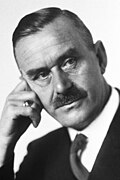
 Germany
Explanation
Thomas Mann wrote a book called “Buddenbrooks” about a family of merchants living in a German town. In the story we follow the grandfather, the father, and the children through many years. Their shop sometimes earns a lot of money, and at other times they face illness or sadness, just like real families do. By describing people’s feelings kindly and accurately, Mann touched readers all around the world. Because of this, he received the Nobel Prize in Literature, one of the most important awards for writers. If you try writing a story about your own family or friends, you might understand a bit of how Mann thought.
Related Keywords
Buddenbrooks
Published when Mann was only 26, this novel fuses elements of family saga, bourgeois novel, and historical fiction. By charting a merchant dynasty’s rise and fall, it visualizes structural change in fin-de-siècle Germany and explores the tension between economic rationality and spiritual culture. Its inclusion of business data and liturgical rituals makes it a quasi-historic document. The psychological passages show Freudian influence, signaling the dawn of early modernism. A worldwide bestseller upon release, it became a template for later family novels.
Fin-de-siècle Germany
This term refers to the German Empire from the late 19th century to the eve of World War I. Rapid industrialization and urbanization unsettled traditional hierarchies and religious certainties, forcing the bourgeoisie to renegotiate its identity. In arts, naturalism, symbolism, and the budding expressionism coexisted, marking a culturally transitional period. Politically, Bismarck’s social insurance schemes and labor laws introduced new tensions among social strata. “Buddenbrooks” condenses these upheavals into the microcosm of a single family.
Generational decline
A structural theme of the novel showing stepwise value shifts from the founding patriarch to the artistically inclined fourth-generation heir. As economic success grows, family cohesion and spiritual fulfillment erode, serving as a metaphor for rising entropy. The motif anticipates Karl Mannheim’s sociology of generations, highlighting shared historical experience as identity-forming. Business-family studies still cite the novel as a literary illustration of the life-cycle model from foundation to decline. The Nobel Committee’s “modern classic” label rests partly on this universal insight.
Bourgeoisie
The middle-class layer that rose within modern capitalism through economic power and education. Mann’s novel portrays the bourgeoisie’s ethical codes, cultivation, religiosity, and business motives as intertwined yet contradictory. By juxtaposing meticulous ledgers with ornate social soirées, “Buddenbrooks” spotlights bourgeois ethics’ limitations. Comparative readings with Weber’s Protestant Ethic are common, probing the duality of spirit and economy. Contemporary critiques of capitalism still cite the novel as an early case study of the dilemma between cultural consumption and self-realization.
Literary realism
A literary movement from the mid-19th century onward aiming for objective, detailed depiction of society and individuals. Mann revitalized realism by blending documentary techniques with deep psychology, thereby reproducing reality’s multi-layered texture. In “Buddenbrooks,” concrete data—ledgers, meal menus, weather notes—give readers a tactile sense of time and place. These details contrast with the later modernist focus on inner consciousness and temporal experiments, marking a pivotal point in 20th-century literary history. Realism studies often debate the balance between ‘information density’ and ‘symbolic layering,’ and Mann’s novel is a staple example.