1934 Nobel Prize in Literature
Reason for Award
for his bold and ingenious revival of dramatic and scenic art
Laureates
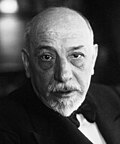
 Italy
Italy
Explanation
Luigi Pirandello changed theatre to make it more exciting and thought-provoking. In his plays, characters wonder, “Who is my real self?” and sometimes talk directly with the audience. It feels like a classroom where everyone helps create the story. He shows us the “masks” we put on and take off in everyday life. Because of this, viewers notice they also have many different faces. Thanks to Pirandello, the stage became a fun place for games and experiments. Today’s musicals and dramas still use his ideas.
Related Keywords
meta-theatre
A technique that makes theatre itself the theme within a play, forcing actors and audiences to notice the mechanics of staging. Pirandello used it to blur the boundary between reality and fiction and to layer narrative structures. Viewers become participants in the creative act instead of passive observers. The method underpins Brechtian theatre and contemporary performance art. In theatre studies it is often analyzed as a prime case of self-referentiality.
multiplicity of identity
The idea that people possess different “faces” or “masks” depending on context. In Pirandello’s works protagonists behave like entirely different persons, never settling into one fixed self. This challenges modern notions of individualism and influenced psychoanalysis and social psychology. Through his plays, audiences recognize their own multiplicity. It remains a major theme in 20th-century literature.
dramaturgical revolution
At a time dominated by fixed three-act structures and realistic staging, Pirandello redefined plot architecture and scenic design. He boldly omitted conventional scene changes, privileging psychological reality. By dissolving the line between script and improvisation, he strengthened the director-centered creative system. Theatre historians sometimes call this the third great revolutionary phase after Chekhov and Ibsen. His influence even extended to screenwriting techniques.
precursor of the Theatre of the Absurd
The foundations of the post-war Theatre of the Absurd by Ionesco and Beckett germinated in Pirandello’s ontological questioning. Linguistic uncertainty and the breakdown of causality were already present in his plays. In “Henry IV,” madness is used as a mirror of truth, prominently inverting logic. These elements were later radicalized in absurdist drama. Scholars label his work as “proto-absurd.”
mask
A central metaphor in Pirandello’s work symbolizing social roles and self-presentation. Characters confront their naked selves when the mask is removed, often leading to chaos. Linked to Sicilian carnival culture, it invites folkloristic readings. Later theatre theory pairs it with “role-playing,” and the concept influenced Goffman’s sociology. Visually, it was accentuated in stage design.
Sicily
Pirandello’s native region provides the climatic and linguistic backdrop of his universe. Dialect and local lore function as devices that support both realism and fantasy. The island’s enclosed space accentuates characters’ inner drama, elevating it to universal themes. Since Verismo, Sicilian literature has fused social critique with folklore, and Pirandello added a unique metaphysical angle to that lineage. The interplay of regionality and universality became a key factor in his acclaim.
Six Characters in Search of an Author
Premiered in 1921, this signature play depicts characters from an unfinished story who appear on stage demanding their author. Its play-within-a-play structure and multilayered timelines were revolutionary, destabilizing the audience’s viewpoint. Though it initially met with boos, it was later hailed as a landmark of 20th-century theatre. The piece has been translated and restaged worldwide, serving as a textbook example of meta-theatre. It epitomizes the qualities cited in Pirandello’s Nobel Prize statement.