1944 Nobel Prize in Literature
Reason for Award
for the rare strength and fertility of his poetic imagination with which is combined an intellectual curiosity of wide scope and a bold, freshly creative style
Laureates
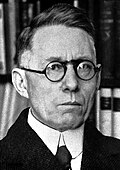
 Denmark
Explanation
Johannes Vilhelm Jensen was a storyteller from Denmark. He wrote with excitement about how people and animals live and change. For example, he pictured ancient people traveling and opening up the world, almost like an adventure tale. Jensen’s words feel alive, letting readers sense the wind or the smell of the forest. He treasured the question “Why?” just like when we do experiments at school. Because of this, many readers felt eager to discover new things after reading his books. His strong and rich imagination and his fresh way of writing earned him the Nobel Prize in Literature.
Related Keywords
poetic imagination
“Poetic imagination” is the power to envision worlds unseen through language. Jensen used scientific facts as raw material and overlaid them with mythic and dreamlike images. As a result, readers can experientially grasp historical events and traverse tens of thousands of years in an instant. His poetic imagination also offered regenerative visions to minds devastated by European warfare. The Nobel Committee valued this strength and fertility as a force that could open new paths for literature.
intellectual curiosity
Jensen voraciously read outside his field, absorbing zoology, geology, anthropology, and more. This interdisciplinary knowledge is naturally quoted and reconfigured in his narratives. Intellectual curiosity is not a mere list of trivia; it deepens the story and conveys the joy of learning to readers. His balance of data gathering and storytelling anticipates today’s nonfiction writing. The Nobel Prize lauded the way he transmuted this broad inquisitiveness into literary value.
The Long Journey
"The Long Journey" is a six-volume historical novel series portraying human evolution and global exploration. It starts with Ice Age hunters in volume one and ends with Columbus’ voyage in volume six. While grounded in scientific research, its character psychology is poetic, blurring the boundary between academic text and epic. Throughout the work, “movement” is presented as the engine of evolution and cultural development. Upon publication it attracted attention not only in the Nordic region but also in English- and German-speaking worlds, cementing Jensen’s international reputation.
Danish literature
Danish literature has produced many storytellers such as Hans Christian Andersen and Karen Blixen. Within this lineage, Jensen forged a unique horizon by combining rural dialects with scientific perspectives. His experimental spirit has influenced later poets like Ingeborg Lütken and contemporary novelist Peter Høeg. At the time, he was only the second Danish recipient of the Nobel Prize in Literature. By linking Danish literature to the network of world literature, Jensen’s legacy remains significant today.
literary modernism
Literary modernism is an artistic movement from the late 19th to early 20th centuries that dismantled traditional forms and linear time. Jensen’s sharp, concise prose and his use of multiple viewpoints align with modernist characteristics. His works make “streams of inner consciousness” visible through experiments in intersecting timelines. Consequently, readers can experience characters’ thought processes more directly. Modernist studies frequently cite Jensen as a pioneering figure in the Nordic context.
Himmerland Tales
"Himmerland Tales," first published in 1898, is a short-story collection portraying rural life and nature in the Jutland region. Its respect for dialect aimed to re-weave Danish oral traditions into written culture. Humor and harsh reality coexist in the stories, highlighting the complexity of regional culture. The work attracted folklorists at home and abroad, enhancing its value as a cultural record. It is essential for understanding the breadth of Jensen’s literary style.
theory of evolution
The theory of evolution asserts that living beings continually change through adaptation to their environment. Inspired by Darwin, Jensen interpreted human history from an evolutionary standpoint. His novels employ concepts like heredity and natural selection as metaphors, shaping the skeleton of the narrative. This scientific viewpoint enabled a dynamic time scale rare among writers of his era. Engagement with evolutionary theory is regarded as a pivotal experiment that blurred the boundary between literature and science.