1946 Nobel Prize in Literature
Reason for Award
for his inspired writings which, while growing in boldness and penetration, exemplify the classical humanitarian ideals and high qualities of style
Laureates
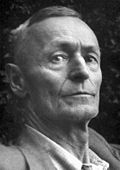
 Germany,
  Switzerland
Explanation
Hermann Hesse was an author who wrote stories about how people grow and worry. When you read his books you start to wonder, “Who am I?” In “Siddhartha,” for example, the hero listens to the river while travelling from boyhood to adulthood. Hesse cared about people hurt by war and wished for a world where everyone helps each other. His writing looks simple and gentle but hides deep meaning. These loved works all over the world earned him the Nobel Prize in Literature.
Related Keywords
Demian
“Demian” (1919) is one of Hesse’s signature works, written just after World War I. It follows the boy Sinclair as he is guided by the enigmatic Demian to establish his own identity beyond conventional morality. The heretical god Abraxas is introduced as a symbol that transcends the Christian dichotomy of good and evil. Dreams, visions, and images of light and darkness echo Jung’s later theory of archetypes throughout the text. As a Bildungsroman on adolescent identity, the novel strongly influenced 20th-century youth culture.
Siddhartha
“Siddhartha” (1922) is set in ancient India and follows a young man’s quest for enlightenment. Buddhist and Hindu elements are interwoven, and the murmuring river functions as a symbol of time and existence. The protagonist experiences both asceticism and sensuality, eventually realising that “all is one.” Hesse’s personal engagement with Eastern thought culminated here, pushing the novel beyond the confines of German Expressionism. It remains a classic of spiritual literature and has been translated into numerous languages.
Steppenwolf
“Steppenwolf” (1927) is an avant-garde novel about urban loneliness and psychic split. Its hero Harry Haller suffers between his “man” and “wolf” selves. The concluding “Magic Theatre” blends fantasy and reality in an experimental structure that invites multiple readings. References to jazz, dance halls, and other contemporary pop culture cross the boundaries between literature and music. Rediscovered by the 1960s counterculture, the book influenced rock bands and cinema.
The Glass Bead Game
“The Glass Bead Game” (1943) is Hesse’s late magnum opus set in the fictional pedagogic province of Castalia. Protagonist Joseph Knecht becomes “Magister Ludi,” master of an abstract game synthesising music, mathematics, and philosophy. The novel portrays the tension between ivory-tower specialization and social responsibility, serving as a critique of intellectuals under World War II. Embedded biographies, parables, and archival fragments anticipate the multi-layered structures of postmodern fiction. It influenced intellectual history, educational theory, and the history of science and was a central factor in his Nobel citation.
Bildungsroman
The Bildungsroman is a literary form tracing a protagonist’s path to spiritual maturity, rooted in Goethe’s “Wilhelm Meister.” Hesse inherited this tradition but evolved it by incorporating modern alienation and the scars of war. His novels prioritize inner journeys over external events, using dreams and symbols as markers of growth. This approach affected not only 20th-century fiction but also developments in psychology and pedagogy. The Nobel citation’s phrase “classical humanitarian ideals” refers to the ethical dimension embedded in the Bildungsroman.