1949 Nobel Prize in Literature
Reason for Award
for his powerful and artistically unique contribution to the modern American novel
Laureates
 United States of America
Explanation
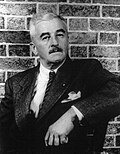
William Faulkner was a writer who set many of his stories in the American South long ago. His books include many kinds of people—grandfathers, children, and Black characters, too. He often shows the same event through different eyes, making the story feel like a puzzle. Faulkner invented a make-believe county called “Yoknapatawpha” and used it again and again. In that county we see joy, sorrow, friendship, and unfair treatment. His stories can be hard to read, but they help us think deeply about families and the history of a town.
Related Keywords
stream of consciousness
A narrative device Faulkner frequently used, writing characters’ thoughts in an unfiltered flow that ignores standard punctuation and tense. Sensory order overrides logical order, giving readers the sense of entering the character’s mind. Alongside Joyce and Woolf, it is emblematic of modernist fiction and deepens psychological portrayal. Because story time and narrative time diverge, reconstructing chronology becomes central to interpretation. In Faulkner, the mental turbulence parallels the fractured Southern society, yielding political resonance.
Yoknapatawpha County
A fictional Mississippi county created by Faulkner and used in over thirty works. He even drew maps, detailing rivers, towns, and family lines. Critics call it a microcosm that condenses Southern history and race relations. Recurring characters and events let readers assemble a composite picture across novels. The device later influenced García Márquez’s Macondo and Steinbeck’s Salinas Valley.
Southern Gothic
A literary mode focused on decay, violence, and the grotesque in the American South. Motifs include ruined mansions, cursed families, and racial oppression. Faulkner redefined the tradition by emphasizing psychological horror and social critique rather than supernatural shocks. Amid the darkness he exposes human dignity and invites ethical questioning. The lineage continues in Flannery O’Connor and Carson McCullers.
narrative polyphony
A technique in which multiple narrators or viewpoints describe the same events from different angles. Faulkner staggers these voices in time, foregrounding the relativity of truth. Each narrator’s speech register mirrors social class or race, creating an embedded sociological field within the text. He is a pioneering English-language embodiment of Bakhtin’s idea of polyphony. The device has influenced contemporary ensemble novels and multi-perspective filmmaking.
nonlinear chronology
A structure in which events are presented out of their actual sequence, moving freely among past, present, and future. Faulkner dismantles time through stream of consciousness and memory fragments, spotlighting subjective experience. Readers reassemble the timeline like a puzzle, discovering thematic layers with each pass. The principle has informed design thinking for hypertext and digital fiction. The gap between physical and psychological time acts as a critical mechanism exposing Southern historical trauma.
race relations
The power dynamics and discriminatory structures between white and Black communities in the American South. Faulkner’s fiction interweaves the legacy of slavery and issues of miscegenation into family histories, generating tragedy. His inclusion of Black viewpoints was groundbreaking for a white writer of his era. Readers confront prejudice not only in legal systems but also in everyday speech and silence. The works stand as an early literary resistance preceding the Civil Rights Movement.