1964 Nobel Prize in Literature
Reason for Award
for his work which, rich in ideas and filled with the spirit of freedom and the quest for truth, has exerted a far-reaching influence on our age
Laureates
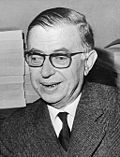
 France
Explanation
Jean-Paul Sartre was a French writer who created stories and plays. His books teach that 'people should make their own choices and take responsibility for them.' It is like deciding for yourself whether to play with friends or do homework and then standing by that decision. This idea encourages everyone to value freedom and live honestly. Because his words inspired so many people, Sartre was chosen for the Nobel Prize in Literature. However, he said he wanted to stay free from any title and politely refused the prize. By doing so, he showed once more how important it is to follow your own choice.
Related Keywords
existentialism
A 20th-century philosophical movement that holds humans first exist and then define themselves. Sartre popularized it by focusing on 'freedom and responsibility.' His lecture 'Existentialism is a Humanism' influenced not only specialists but also students and workers. The movement permeated literature, theatre, and cinema, shaping post-war European culture. It remains a framework for discussing self-determination and identity today.
existential angst
A fundamental uneasiness that arises from realizing one’s choices decide the world. Sartre analyses it as 'the weight of freedom here and now.' Roquentin, the protagonist of 'Nausea,' perceives meaninglessness in ordinary scenes and confronts this angst. Existential angst can paralyze but also push individuals toward authentic action. In psychology and psychiatry it is cited to explain identity crises.
freedom
In Sartrean philosophy, freedom is not an essence but a condition, functioning as an inescapable command. We are always faced with decisions to the extent that even 'not choosing' is impossible. Because of freedom, individuals bear full responsibility for their acts, a weight experienced as anxiety. Sartre concretized freedom by supporting anti-colonial struggles and labor movements. His active notion of freedom became a theoretical pillar for later liberation philosophies and human-rights movements.
bad faith
Self-deception in which a person identifies with social roles or conventions in order to forget freedom. Sartre’s famous example is the overly mechanical café waiter who clings to his role. Bad faith offers comfort but confines people to automatic behavior and blocks creative agency. Becoming aware of and overcoming it is central to existentialism. Today the concept is cited when discussing workplace identity or self-presentation on social media.
the Other
Refers to subjects other than oneself; Sartre analyzes how the gaze of the Other objectifies the self. The resulting feeling, 'shame,' shows that self-understanding is influenced from outside. The Other can be both adversarial and cooperative, providing the basis of social relations. The famous line from 'No Exit,' 'Hell is other people,' encapsulates this tension. Debates on alterity in feminism and post-colonial theory later drew heavily on this concept.
Nausea
'Nausea,' published in 1938, is one of Sartre’s seminal novels, told in diary form through the existential experiences of protagonist Roquentin. He feels ordinary objects and actions become needless and is overwhelmed by the sheer 'existence' of the world. The work fuses linguistic uncertainty with philosophical reflection in a literary style. It is seen as the starting point of existentialist literature and prompted many readers to rethink their own being. Its transgression of the boundary between philosophy and fiction influenced later experimental writing.
Being and Nothingness
Published in 1943, this philosophical treatise systematizes Sartre’s thought and is considered his magnum opus. Through an analysis of consciousness it argues that humans, by means of 'nothingness,' carve up the world. Key notions such as existential anxiety, bad faith, and the gaze of the Other are elaborated in detail. Despite its difficulty the book influenced literature, psychology, and political theory, generating numerous critiques and developments. It remains a foundational text for anyone studying existentialism.
declining the Nobel Prize
In 1964 Sartre refused to accept the Nobel Prize in Literature for personal and political reasons. He had long believed that official honors threaten a writer’s independence and had previously rejected French decorations. The decision sparked debate and forced reconsideration of the prize’s authority and cultural institutions. Sartre did not deny the value of the award itself; he simply did not want it attached to his name and declined the money. The episode is remembered as a concrete embodiment of his credo that a free subject must choose for himself.