1970 Nobel Prize in Literature
Reason for Award
for the ethical force with which he has pursued the indispensable traditions of Russian literature
Laureates
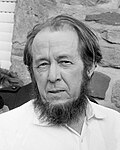
 Soviet Union
Explanation
Aleksandr Solzhenitsyn was a Russian writer who used books to show why it is important for people to live freely. He turned hard experiences that he and his friends had into stories so readers could notice unfairness in the world. In his book “One Day in the Life of Ivan Denisovich,” for example, he describes in detail a single day of people forced to work in a cold prison camp. Readers feel strongly that such things should never happen. Because his brave writings gave people around the world hope and something to think about, he received the Nobel Prize in Literature.
Related Keywords
The Gulag Archipelago
Published abroad in 1973, “The Gulag Archipelago” is a trilogy based on Solzhenitsyn’s own memories plus testimonies from over 200 witnesses, offering a systematic portrait of the Soviet forced-labor camp network. Mixing novelistic narrative, historical documents, statistics, and oral accounts, it confronts readers with state violence from multiple angles. Immediately after release it became a bestseller in the West and decisively shifted public opinion about communism. Inside the USSR it was banned so rigorously that mere possession risked punishment, yet it circulated clandestinely via samizdat. Today it is cited as a pioneering model for human-rights reports and truth-commission documents.
One Day in the Life of Ivan Denisovich
Published in 1962 in the journal Novy Mir, it drew attention as the first literary work that officially criticized Stalin. The story depicts a single prisoner’s day in a freezing labor camp with exhaustive micro-detail, allowing readers to feel oppression’s everyday texture. Its concise, colloquial style contrasted sharply with the heroic narratives of socialist realism. The publication became an emblematic event of the brief liberal “Thaw.” Later banned again, it laid the foundation for the camp-literature genre within world literature.
Gulag
The term Gulag refers to the Main Administration of Corrective Labor Camps under the Soviet NKVD, which imprisoned millions between the 1930s and 1950s. Camps were scattered across Siberia, the Arctic, Central Asia, forming the largest network of forced-labor sites in history. Harsh work conditions and poor sanitation caused huge mortality, while economically the camps supplied labor for mining and grand construction projects. Solzhenitsyn’s writings first brought a systematic picture of the Gulag to world attention, and the word has since become a common noun. It remains a vibrant research topic at the intersection of history, human-rights studies, and memory politics.
Russian literary tradition
Nineteenth-century Russian literature, exemplified by Tolstoy and Dostoevsky, is renowned for a weighty realism that probes the human soul and social ethics. Solzhenitsyn inherits this tradition yet innovates by centering religious-moral questions on the realities of twentieth-century political violence. His polyphonic structures and extended philosophical monologues align with Bakhtinian dialogism. Engaging in explicit dialogue with past classics while introducing contemporary themes, he re-verifies the “indispensability” of that tradition. This contrapuntal method is viewed as generating the “ethical force” noted by the Nobel Committee.
Censorship
In the USSR, the state organ Glavlit performed pre-publication censorship, eliminating content critical of the regime. Solzhenitsyn exploited a brief thaw in the 1960s to publish but his works were soon banned again. He smuggled manuscripts via microfilm and couriers to Western publishers, breaching information blockades. The struggle with censorship heavily shaped the textual genesis and publishing formats of his works, offering a prime case for literary sociology. Even after the Cold War, it remains a classic example in comparative studies of state control over expression.
Dissident
The term dissident refers to citizens or intellectuals who challenge the regime and demand human rights, widely used in the USSR and Eastern Europe. Solzhenitsyn, leveraging his literary fame and global attention, became a leading dissident figure. His success in publishing abroad paved the way for other underground writers and prompted international bodies to monitor Soviet human-rights conditions. During the 1970s, dissident activity expanded through the Helsinki Accords, the Sakharov Committee, and similar networks, preparing social change in the late Cold War. The word remains a key concept when discussing civic resistance in contemporary authoritarian states.
Moral courage
Moral courage is the psychological and ethical strength to act on one’s convictions despite personal risk or loss. Solzhenitsyn exemplified it by continuing to publish despite imprisonment and exile. His stance spurred debates on the social responsibility of artists and is often cited to justify intellectuals’ participation in the public sphere. In education, his life is used as material for teaching civic virtues. The concept is likewise central in global human-rights activism and journalism ethics.