1972 Nobel Prize in Literature
Reason for Award
for his writing which through its combination of a broad perspective on his time and a sensitive skill in characterization has contributed to a renewal of German literature
Laureates
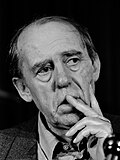
 Germany
Explanation
Heinrich Böll wrote stories about ordinary people living in Germany after the war. The characters are parents, soldiers, shop-owners—people we might meet in real life. Böll avoided very difficult words so that many readers could understand the feelings in his books. Readers can share the sadness and joy of the characters as if it were their own. By writing in this clear, friendly style, Böll refreshed old-fashioned German literature. Thanks to him, people around the world became interested in German stories again.
Related Keywords
post-war German literature
The term refers to German-language literature after 1945, also known as Trümmerliteratur (“rubble literature”). Central themes include defeat, occupation policies and economic recovery. Heinrich Böll is a key figure, portraying conflicts between personal ethics and social structures. His works try to balance coming to terms with the past and assuming responsibility for the future. In international comparison, the current developed its own path while conversing with Japanese post-war writing and French existentialist literature.
critical realism
A literary tendency that depicts reality in realistic detail while foregrounding underlying power relations and moral issues. In Böll’s novels, seemingly ordinary scenes acquire political resonance. Readers are invited not merely to observe the fictional world but to reassess their own society critically. In Germany it continues the tradition of Theodor Fontane while addressing post-war ethical questions. The approach also influences contemporary documentary literature and socially engaged cinema.
“Billiards at Half-past Nine”
Published in 1959, this novel portrays the lingering impact of Nazism through three generations of an architect family. Set mainly on 6 September 1958, it employs a polyphonic structure mixing memories and interior monologues. The symbolic building of St Elizabeth’s Abbey embodies the conflict between society and conscience. Critics often consider it Böll’s artistic pinnacle and a warning against West German rearmament. The text is frequently examined from perspectives such as memory studies and spatial theory.
“The Lost Honour of Katharina Blum”
Released in 1974, this novella-length work shows how tabloid manipulation destroys the life of an ordinary woman. Written as an investigative report, it exposes the violence of mass media and the complicity of readers. The fictional newspaper alludes to the real tabloid Bild, sparking intense debate upon publication. The text is now a classic reference for issues of press ethics, privacy rights and fake news. Its film adaptation is regarded as a pioneer of media-critical cinema.
Group 47
An informal circle of writers and critics active from 1947 to 1967 in West Germany. Meetings featured readings of unpublished texts followed by immediate critiques; members included Böll, Grass and Walser. Rejecting formalism and political evasiveness, the group emphasised linguistic transparency and social responsibility. It produced several Nobel laureates and greatly aided the international rehabilitation of German literature. As a model of literary salon, Group 47 has influenced creative-writing workshops worldwide.