1976 Nobel Prize in Literature
Reason for Award
for the human understanding and subtle analysis of contemporary culture that are combined in his work
Laureates
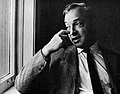
 United States of America
Explanation
Saul Bellow is a writer who tells stories. His books show the feelings and worries of ordinary city people. He describes friendship, family, school and work troubles in words that are easy to picture. When readers realize they have felt the same, his stories connect with them all over the world. He also explains the confusing rules and fashions of modern society as if using a magnifying glass. Because of this clear look at human hearts and today’s world, the Nobel Committee gave him the prize.
Related Keywords
Jewish American literature
Jewish American literature refers to works in English by Jewish immigrants and their descendants, exploring themes such as faith, exile, and the struggle to assimilate. Saul Bellow stands at its center, portraying secular Jewish intellectuals navigating big-city life and religious tradition. His fiction plumbs layered identities, exposing the intricate weave of cultural backgrounds. Consequently, the field symbolizes the diversity of American letters and remains crucial for immigration and diaspora studies. It also functions as a vehicle that carries minority voices into mainstream culture.
urban life
Much of Bellow’s fiction unfolds in megacities like Chicago and New York, where noise and crowding mirror the characters’ mental states. Skyscrapers, subway clatter, and street slang ground his narratives in palpable detail. The city is presented dually as a space of opportunity and of alienation. By showing how the speed and data overload of modern life unsettle self-conceptions, he prompts readers to reassess their own surroundings. This urban portrayal aligns closely with sociological and geographical approaches, making his work fertile ground for interdisciplinary studies.
search for identity
The persistent question of who one really is forms the core of Bellow’s fiction. His protagonists—immigrants’ children, intellectuals, divorcés—embody clashing roles that destabilize the self. Psychological, philosophical, and religious reflections are woven into the plot, dramatizing inner struggle. Readers thus experience the interplay between personal history and social structure, reliving a universal search for self. The theme resonates strongly with contemporary identity studies in multicultural societies.
satire
Bellow wields sharp humor to pierce social hypocrisy and materialism. Money worship, media manipulation, and academic pomposity are exposed through ironic dialogue and exaggeration. Laughter functions not merely as entertainment but as a device that reveals power relations and demands ethical judgment. His satire adapts classical traditions to modern contexts and serves as prime material for critical theory. By linking social critique with personal renewal, his storytelling influenced many later postmodern authors.
existential anxiety
Characters in Bellow’s novels often feel emptiness and loneliness even when outwardly successful. Influenced by twentieth-century existentialism, he gives philosophical weight to everyday events. Awareness of time and inevitable death permeates consciousness and shapes decisions. Readers experience the question of life’s meaning alongside the narrative, prompting self-reflection. This existential anxiety links his work to debates in psychology and theology and is studied across disciplines.
colloquial narrative voice
Bellow blends colloquial speech with elevated rhetoric, creating intimacy and intellectual stimulation at once. Readers feel they are “hearing” the characters’ monologues, deepening immersion. Colloquial diction also signals social class and cultural background, reinforcing realism. At the same time it allows philosophical reflection to slide smoothly into everyday talk, letting scholarly debate and street banter coexist without friction. Critics view this style as an innovative expansion of narrative possibilities in modern English fiction.
bildungsroman
“The Adventures of Augie March” employs the classic bildungsroman framework while portraying clashes between traditional morals and modern values. The protagonist’s journey of self-formation parallels the young nation’s quest for identity. Bellow refreshed the genre by adding humor and social critique. Readers relive the hero’s changes and reflect on their own maturation. Historically, the novel stands out for adapting the nineteenth-century European bildungsroman to an American context.