1978 Nobel Prize in Literature
Reason for Award
for his impassioned narrative art which, with roots in a Polish-Jewish cultural tradition, brings universal human conditions to life
Laureates
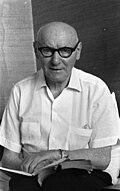
 United States of America,
  Poland
Explanation
Isaac Bashevis Singer wrote stories in Yiddish, a language once spoken by many Jewish people in Poland. His tales talk about families, friends, and helping each other when life is hard—things everyone in the world can understand. When you read them, you notice that events in a far-away place still feel close to your own life. The stories show how fun reading can be and why caring for others is so important. That is why he received the Nobel Prize in Literature. You, too, can read stories and imagine many different people’s feelings.
Related Keywords
Yiddish
A Jewish language of the Germanic family that emerged in Central and Eastern Europe in the late Middle Ages. Written with Hebrew characters and enriched by Hebrew and Slavic vocabulary, it developed a vibrant secular culture of theatre, newspapers, and fiction by the late nineteenth century. Holocaust devastation and mass emigration drastically reduced its speakers. Singer, one of the few authors to gain global acclaim while writing exclusively in this endangered language, demonstrated the literary potential of minority tongues. His Nobel Prize became a symbolic case study in small-language literary viability.
Polish-Jewish culture
The aggregate of religious, social, and artistic practices fostered by Jewish communities settled in the Polish-Lithuanian realm since the Middle Ages. It encompasses Hasidic mysticism, klezmer music, and the communal ethics of the shtetl. During the 19th–20th centuries it forged a complex identity under simultaneous pressures of modernization and anti-Semitism. Singer’s fiction captures fading memories of this milieu, providing both ethnographic detail and mystical narratives that serve as cultural-historical sources. Scholars use his texts to examine the impact of modernization on ethnic culture and the mechanisms of memory transmission.
Diaspora literature
A literary category focusing on the sense of loss and hybrid identity experienced by communities living away from their ancestral homeland. Marked by linguistic and cultural hybridity, diaspora narratives often layer temporal and spatial structures to mirror migratory experiences. Multiple traditions exist, including Jewish, Armenian, and African diasporas. Writing in America yet recalling Poland, Singer used Yiddish to dramatize the tension between linguistic distance and cultural memory. His oeuvre stands as a prime case in diaspora studies for how language choice functions as a strategy of cultural reconstruction.
Magical realism
A narrative technique in which supernatural elements blend seamlessly with realistic depiction, allowing readers to accept both simultaneously. Although famous in Latin American fiction, earlier manifestations exist in Eastern European and Jewish literatures. In Singer’s short stories, demons and spirits intertwine with everyday conflicts, symbolically presenting religious and psychological truths. Such portrayal re-introduces mysticism and folk belief sidelined by modern rationalism, offering a multi-layered view of reality. Scholars use Singer to expand comparative studies of magical realism and to analyze its intersections with religiosity.
Shtetl
A small Jewish settlement in Eastern Europe characterized by communal life and semi-autonomous governance. It typically developed around a market square and synagogue, with Yiddish as the primary language. Most shtetls vanished during late-imperial upheavals and the Holocaust. Singer meticulously portrayed their landscapes, trades, and religious rituals, helping to preserve their historical memory. Historians and anthropologists now consult his fiction as supplementary material in shtetl studies.