1981 Nobel Prize in Literature
Reason for Award
for writings marked by a broad outlook, a wealth of ideas and artistic power
Laureates
 United Kingdom of Great Britain and Northern Ireland
Explanation
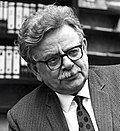
Elias Canetti was a writer who spoke many languages and wrote about how people feel and behave when large groups gather. The Nobel Prize in Literature is a very big award given to the best writers in the world. In 1981, Canetti received it for books like “Crowds and Power.” When lots of people come together, they can feel excited, scared, or act in surprising ways. Think about a school sports day or a local festival and you will get the idea. Canetti’s books give easy-to-understand hints about those feelings. So even if his works look difficult, they actually help us think about everyday life.
Related Keywords
Crowds and Power
Canetti’s major non-fiction study. Using fragmentary chapters, it fuses history, ritual studies, and ethology to analyze how crowd psychology interlocks with power. It critically inherits Le Bon’s mass theory, classifying crowds into states such as “discharge,” “tightening,” and “waiting,” and maps the dynamics of power acquisition. The blend of literary metaphor and scholarly observation makes it a celebrated bridge between the social sciences and the humanities.
Auto-da-Fé
Published in 1935, this novel follows Herr Kien, an aging scholar who barricades himself among books and descends into madness. Set against interwar Vienna, where totalitarian and anti-intellectual currents were rising, the narrative allegorizes the precarious link between knowledge and isolation. Meticulous psychology and symbolic imagery sharply expose the collapse of the individual under oppressive forces.
Autobiographical Trilogy
Comprising The Tongue Set Free, The Torch in My Ear, and The Play of the Eyes, this memoir covers childhood in Bulgaria, youth in Vienna, and exile in London. It details multilingual environments, layered identities, and the experience of displacement. Vivid accounts of language acquisition and reading life render it a valuable document of a 20th-century European intellectual’s transnational existence.
Multilingualism
Canetti spoke Ladino, Bulgarian, German, English, and more. This experience informed his etymological digressions and metaphor production, with inter-lingual gaps acting as creative catalysts. His multilingual sensibility offers clues for expanding literature beyond the confines of national canons.
Psychology of Power
Canetti viewed power not merely as an instrument of decision-making but as continuous with primal human drives. Through examples such as rituals, armies, and religious processions, he shows how power amplifies the crowd’s desire for “closeness.” This perspective has influenced not only political theory but also social psychology and cultural studies.
Mass Hysteria
An excessive shared emotion within a crowd that overrides reason and spreads rapidly. Canetti treats it as a key feature of the “discharge” phase, analyzing the explosive energy seen in festivals and riots. Unlike the strict medical term, his usage operates as a bridge between literary imagery and social critique.