1982 Nobel Prize in Literature
Reason for Award
for his novels and short stories in which the fantastic and the realistic are combined in a richly composed world of imagination, reflecting a continent's life and conflicts
Laureates
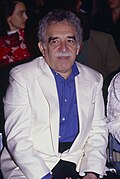
 Colombia
Explanation
Gabriel García Márquez was a writer from Colombia. He wrote stories like “One Hundred Years of Solitude.” In his books, amazing things happen—people may fly or it may rain for years—yet characters act as if it is normal. This style is called magical realism. Through it he tells the history and daily life of South America and makes readers everywhere feel wonder.
Related Keywords
magical realism
Magical realism is a narrative mode in which supernatural events appear in everyday settings and are accepted as normal by the characters. Grounded in Latin American and Caribbean myth and folklore, it allegorizes historical violence and oppression. In Márquez’s fiction, rain of flowers or walking dead relatives illustrate the technique. The mode expands the boundaries of reality and voices stories silenced by colonial histories. Its influence extends beyond literature into film and visual arts worldwide.
Latin American Boom
The Latin American Boom refers to the 1960s–70s surge of internationally acclaimed Spanish-language writers. Márquez, Vargas Llosa, and Cortázar were prominent figures. Their work was marked by narrative innovation, political engagement, and formal experimentation. Cold-War curiosity and aggressive translation campaigns by major publishers propelled the Boom. The movement redrew the map of world literature and broadened readership beyond Euro-American centers.
One Hundred Years of Solitude
Published in 1967, this signature novel chronicles a century in the Buendía family and the town of Macondo. Its cyclical structure and prophetic narration destabilize linear time, making readers feel the weight and repetition of history. Dictatorship, corporate exploitation, and civil wars are allegorized within the story. Translated into more than 40 languages, it has sold over 30 million copies. The book is considered a cornerstone of magical realism and has profoundly influenced subsequent writers.
Macondo
Macondo is the fictional town that recurs in Márquez’s work, modeled on his Colombian hometown Aracataca. Its cycles of isolation and sudden connection mirror Latin America’s historical tides. Events such as a banana-company massacre embed real incidents into allegory. Macondo functions as a space where reality, myth, and dream intermingle. In literary studies it is a key example of an ‘imagined geography.’
collective memory
Collective memory denotes the shared and continuously reshaped narratives of the past held by a group. Márquez overlays family records with regional chronicles, showing how private recollections melt into public history. The narrator in “One Hundred Years of Solitude” destabilizes reliability, revealing history’s polyphony. This strategy is read as post-colonial recuperation of suppressed histories. The concept intersects with sociology and anthropology.
political violence
Latin America has endured decades of violence from civil wars and dictatorships. Márquez integrates events like the banana-company massacre into his stories, bringing victims’ voices to the surface. The fantastic frame both defamiliarizes and normalizes violence, highlighting its pervasiveness. Readers cannot distance themselves and must reconsider ethical responsibility. Literature thus records violent histories and shapes social memory.
family saga
The seven-generation story of the Buendía family exemplifies the family-saga genre, where private lives intersect with history. The repetition of names symbolizes cycles of identity and forgetting. Chains of guilt and hope across generations reveal how history shapes individual choices. Because the form spans long periods, it mirrors large-scale social change. The saga stands alongside Tolstoy and Faulkner in the global lineage of the genre.
Latin American historical context
Márquez’s work rests on a complex backdrop of colonial rule, caudillo dictatorships, and dependent capitalism. His stories weave these events allegorically, representing the experience of the entire continent rather than a single nation. Knowing the historical context clarifies the political charge embedded in fantastic scenes. Issues of linguistic hybridity and multi-ethnic society are also keys to interpretation. The novels exemplify the mutual illumination of literature and history.