1987 Nobel Prize in Literature
Reason for Award
for an all-embracing authorship, imbued with clarity of thought and poetic intensity
Laureates
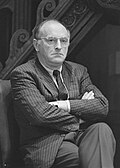
 United States of America
Explanation
Joseph Brodsky was born in Russia and worked in the United States as a poet. His poems use clear thoughts and strong feelings rather than difficult words. The Nobel Prize in Literature is given to people who write great works that reach readers’ hearts. Brodsky wrote many poems about freedom and time. His words have the power to travel across countries and speak to children far away. That is why he received the most famous literary prize in 1987.
Related Keywords
Exile
The 1972 expulsion by Soviet authorities left an indelible mark on Brodsky’s entire oeuvre. Loss of homeland and linguistic restart in a new country became key sources of poetic tension. Through self-translation he consciously negotiated the gap between Russian and English, exploring multilayered identity. In exile studies, Brodsky stands as a paradigmatic “border-crossing writer,” providing material for analyzing the interplay between political repression and artistic freedom. The Nobel Prize symbolically visualized the global acceptance of exiled authors.
Poetic intensity
Brodsky’s poems are built from dense metrics and symbolic imagery that compress philosophical thought into short lines. Readers receive a dual stimulus: sensory rhythm and logical reflection, making the experience both intellectual and emotional. The Nobel Committee viewed this “intensity” as proof that humanistic insight and artistic technique are inseparable. Critics argue that his metaphors materialize time and memory, resonating ontological questions within the reader’s body. Such intensity remains remarkable even among post-modernist poetry of the late twentieth century.
Formalism
Maintaining strict meter and stanzaic structure while injecting new thematic content is a hallmark of Brodsky’s craft. He applies techniques derived from Russian Formalism and Acmeism, expanding meaning through phonetic patterning. Resisting the prevailing free-verse trend, he presents the paradox of achieving freedom through form. Academically his work is a key case study in prosody and quantitative text analysis. The fusion of formal beauty with philosophical depth continues to influence twenty-first-century poets.
Bilingual expression
After exile Brodsky wrote and lectured while oscillating between Russian and English, practicing active self-translation. He exploited phonetic and semantic slippages between languages to embed multiple cultural viewpoints within a poem. The two languages act as mirrors that amplify layers of meaning, letting readers experience both translatability and untranslatability. In translation studies his practice is a key example for discussing author-driven rewrites. This bilingual expression provided an early model for literature in the age of globalization.
Cultural criticism
In the essay collection “Less Than One,” Brodsky critically interprets poets and historical events, questioning the ethical responsibilities of culture. He examines the role art should play vis-à-vis political systems and encourages readers to adopt an active interpretive stance. His essays frequently appear in university syllabi as texts that bridge aesthetics and moral philosophy. Practicing cultural criticism alongside poetry, he helped redefine the poet as a public intellectual. This approach offers insights into the positioning of culture in today’s media-saturated society.
Theme of time
Brodsky’s works employ distinctive temporal manipulations in which past, present, and future overlap. He contraposes historical events with personal memory, treating time almost as a spatial dimension. Repetition of phonemes and inversion of word order visualize temporal flow, letting readers experience multilayered time. Critics call this the “polyphony of time,” seeing it as an extension of modernist techniques. Exploration of time is closely linked to his status as an exile, functioning as a device to transcend ruptures in place and history.
Ethics and freedom
Experiences of repression under the Soviet regime pushed ethics and freedom to the center of Brodsky’s concerns. His works repeatedly express the belief that language itself can liberate humans beyond state or ideological constraints. In court he proclaimed, “I can only write poetry,” asserting professional freedom. In his Nobel lecture he emphasized that the free individual is the bearer of truth, redefining the writer’s social responsibility. This ethical stance is frequently cited in contemporary discussions on human rights and freedom of expression.