1994 Nobel Prize in Literature
Reason for Award
who with poetic force creates an imagined world, where life and myth condense to form a disconcerting picture of the human predicament today
Laureates
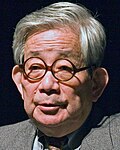
 Japan
Japan
Explanation
Kenzaburo Oe is a Japanese author who has written stories that stay in readers’ hearts. He mixes real events with imaginary worlds so well that readers ask themselves, “What would I do?” For example, he writes about strange happenings in deep forests and about strong family bonds, showing people’s worries and hopes. He also talks about war, nature, and other problems we know from everyday life. Because of this powerful storytelling, he received the Nobel Prize in Literature. Reading his stories can feel like taking a journey to a new place.
Related Keywords
poetic imagination
Oe’s works are marked by rich metaphors and rhythmic language. This “poetic imagination” enables readers to feel situations they have never actually lived through, prompting ethical reflection. He often employs rhythmic repetition and mythic symbols, building a musical architecture inside the narrative. As a result, pain and hope emerge not as abstractions but as bodily sensations. The Nobel Committee highly valued this musical quality of his prose.
fusion of reality and fiction
Oe incorporates real social incidents and personal experiences into his stories, then reshapes them with fantastical elements. This lets readers feel the inherent uncertainty of reality itself. Nuclear disasters or family disability, for example, appear through mythic or dreamlike lenses. The blurred boundary is a hallmark of post-modern literature and reflects today’s information-saturated society. Thus fiction becomes a tool for criticizing reality.
human predicament
The “human predicament” refers to unavoidable difficulties such as war, ecological ruin, and isolation. Oe renders these themes through bodily experience and family narratives, preventing them from becoming mere abstractions. Readers realize they are beings who carry both responsibility and hope. The Nobel citation explicitly stresses this concept.
nuclear and post-war society
The memories of Hiroshima and Nagasaki underpin Japanese society. Oe weaves survivor testimonies and critiques of nuclear testing into his works, showing that nuclear peril persists. By ethically questioning Cold-War deterrence, his stance resonates with peace movements at home and abroad. It exemplifies how literature can converge with social activism.
disability and family
The presence of Oe’s eldest son, Hikari, serves as a catalyst for redefining family in many works. Disability is depicted not as a deficit but as a different possibility, introducing an ethics of care. Readers thus gain a positive view of varied life forms. The topic is frequently cited in disability studies and care ethics research.
ethical responsibility
Characters are often forced to choose whether to save or abandon others. Oe calls the inescapability of such choices “ethical responsibility.” It is a challenge posed not only to states and social systems but also to individual conscience. Readers are drawn into the story as direct stakeholders.
The Silent Cry
Published in 1967, this novel intertwines a village’s past and present, portraying the collapse and possible rebirth of a community. Through fraternal conflict and cycles of revolt, it highlights historical violence and personal guilt. It is considered a representative work where Oe’s mythic method fuses with local imagery.
literary parable
A parable is a short didactic tale, yet Oe often employs parabolic structures in lengthy novels. By mixing myth, folklore, and dream, the story functions as a mirror warning contemporary society. Readers grasp abstract issues through the corporeality of narrative, making complex problems feel close and tangible.