2007 Nobel Prize in Literature
Reason for Award
that epicist of the female experience, who with scepticism, fire and visionary power has subjected a divided civilisation to scrutiny
Laureates
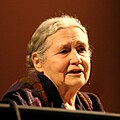
 United Kingdom of Great Britain and Northern Ireland,
  Zimbabwe
Explanation
Doris Lessing was a writer who told wonderful stories. She wrote about women, families and the way different countries sometimes disagree, so that everyone could think about these things. It is like reading a tale that teaches how to get along when you and your friend see the world differently. Because she lived in many places—Britain, Africa and even being born in Iran—her books make the world feel big and exciting. Some ideas are hard, but they help readers care more about themselves and the people around them.
Related Keywords
feminism
Lessing’s texts carved out a space in which women narrate society and history in their own voices. Published amid second-wave feminism, “The Golden Notebook” treats emotion, sexuality and politics on equal footing, asserting holistic female subjectivity. Although not a movement theorist, her literary practice illuminated gender inequality in everyday life. Reading her makes clear that feminism is not just a slogan but a lens on lived experience. Contemporary gender studies still cite her extensively.
postcolonialism
Lessing’s Rhodesian upbringing stamped colonial power dynamics onto her fiction. “The Grass Is Singing” stages the tension between a white farmer’s wife and a Black labourer to expose racial violence. Rather than mere accusation, she probes how colonialism corrodes the coloniser’s psyche. This anticipates postcolonial theory’s focus on ‘internalised empire’. The Nobel citation’s phrase ‘divided civilisation’ nods to this dimension.
epic narrative
The Nobel Committee dubbed her ‘an epicist of the female experience’. Her five-volume “Children of Violence” paints a panoramic twentieth-century landscape through the life of Martha Quest. Personal growth intersects with social upheaval, renewing the epic form from a woman’s perspective. Considering that traditional epics centre on male heroes, this is radically innovative. Using the vast canvas of the long novel to link micro and macro narratives has inspired many later writers.
metafiction
In “The Golden Notebook” the notebooks written by the protagonist constitute the novel’s own structure, compelling readers to reflect on ‘what a story is’. Through such self-referential devices the boundaries between author, reader and character blur. This inherits modernist experimentation while anticipating postmodernism. By making the process of narrative construction visible, the work is seminal in creative-writing studies and narratology. It is a prime example of form-content interaction.
science fiction
Her late “Canopus in Argos” sequence is a space-opera-like SF depicting interstellar civilisations. Ecological collapse, nuclear war and colonialism on Earth echo within a cosmic narrative of spiritual evolution. Blending high literary prestige with science-fiction tropes was controversial then but later reassessed as ‘respectable SF’. This hybrid strategy is pivotal for genre boundary studies. The series also fuels eco-literature and speculative anthropology.
autobiographical element
Lessing’s memoirs “Under My Skin” and “Walking in the Shade” display the porosity between fiction and reality. Her novels repeatedly rework personal experiences, making inter-textual comparison crucial. The gap between autobiographical and narrative truth informs memory and trauma studies. Knowing the author’s life lets readers grasp the sources of her motifs and emotions. In literary criticism her case is often cited in debates on authorship.
Sufism
Idries Shah’s Sufi teachings, popular in 1960s Britain, deeply affected Lessing’s spirituality. Her narratives often hint that inner awakening, rather than external reform, is key—an essentially Sufi idea. Works like “Briefing for a Descent into Hell” (her ‘inner-space fiction’) dramatise journeys into the mind’s depths. This aligns with her scepticism toward Western rationalism, exemplifying cross-cultural philosophical exchange. The concept urges a re-thinking of boundaries between religious and secular literature.